Doubtnut
1,680 old videos with fewer than 5,000 views from this channel.
-
 3:10
If [] denotes the greatest integer and {} denotes the fractional part, then the domain of the
3:10
If [] denotes the greatest integer and {} denotes the fractional part, then the domain of the
-
 2:31
If `y=x^cosx+sinx,` find `dy/dx`
2:31
If `y=x^cosx+sinx,` find `dy/dx`
-
 5:11
The number of rational numbers `p/q`, where `p, q in [1,2,3, 4,5, 6}` is
5:11
The number of rational numbers `p/q`, where `p, q in [1,2,3, 4,5, 6}` is
-
 4:44
If the points `(0,0), (2,3), (3,2), (k,k),(k!= 0)` are concyclic then `k=`
4:44
If the points `(0,0), (2,3), (3,2), (k,k),(k!= 0)` are concyclic then `k=`
-
 3:03
`lim_(x- gt0)[(lncosx)/((1+x^2)^(1/4) -1)]`
3:03
`lim_(x- gt0)[(lncosx)/((1+x^2)^(1/4) -1)]`
-
 3:25
`int 3^x (g^1(x) + g(x) ln3)dx` is equal to
3:25
`int 3^x (g^1(x) + g(x) ln3)dx` is equal to
-
 3:48
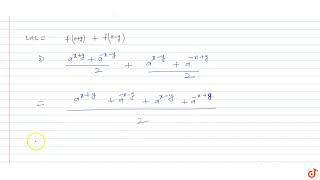
Given the function `f(x)=(a^x+a^-x)/2 (a gt 0)`. If `f(x + y) + f(x-y) = k f(x). f(y)` then k
3:48
Given the function `f(x)=(a^x+a^-x)/2 (a gt 0)`. If `f(x + y) + f(x-y) = k f(x). f(y)` then k
-
 2:33
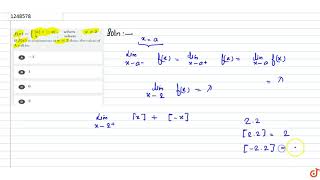
`f(x)={[x]+[-x],` where `x!=2` and `lambda,` where If `f(x)` is continuous at `x=2` then, the
2:33
`f(x)={[x]+[-x],` where `x!=2` and `lambda,` where If `f(x)` is continuous at `x=2` then, the
-
 3:02
Solve : `(d^2y)/(dx^2)=(2x)/((1+x^2)^2);` given that `x=0,(dy)/(dx)=1 and y=2.`
3:02
Solve : `(d^2y)/(dx^2)=(2x)/((1+x^2)^2);` given that `x=0,(dy)/(dx)=1 and y=2.`
-
 3:48
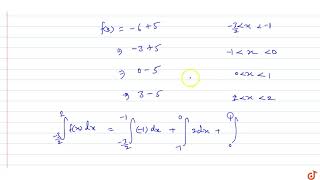
`f(x)={3[x]-5|x|/x, x != 0 and 2 , x=0` where [.] denotes the greatest integer function, then
3:48
`f(x)={3[x]-5|x|/x, x != 0 and 2 , x=0` where [.] denotes the greatest integer function, then
-
 2:57
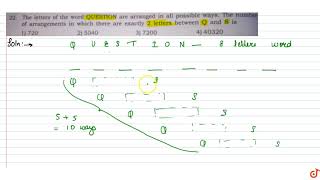
The letters of the word QUESTION are arranged in all possible ways. The numberof arrangements
2:57
The letters of the word QUESTION are arranged in all possible ways. The numberof arrangements
-
 3:18
`f(x)=sin^-1[log_2(x^2/2)]` where [ . ] denotes the greatest integer function.
3:18
`f(x)=sin^-1[log_2(x^2/2)]` where [ . ] denotes the greatest integer function.
-
 3:00
Let L denote the set of all straight lines in a plane.Let a relation R be defined by `alpha R
3:00
Let L denote the set of all straight lines in a plane.Let a relation R be defined by `alpha R
-
 3:02
The maximum area of the triangle formed by the points `(0,0). (acostheta ,b sin theta) and (a
3:02
The maximum area of the triangle formed by the points `(0,0). (acostheta ,b sin theta) and (a
-
 2:15
Value of `tan25^@tan35^@ tan45^@tan55^@ tan65^@` is
2:15
Value of `tan25^@tan35^@ tan45^@tan55^@ tan65^@` is
-
 3:21
The number of real values of x satisfying `tan^-1(x/(1-x^2))+tan^-1 (1/x^3)` is
3:21
The number of real values of x satisfying `tan^-1(x/(1-x^2))+tan^-1 (1/x^3)` is
-
 5:17
The line `y=x` intersects the hyperbola `x^2/9-y^2/25=1` at the points `P and Q.` The eccentri
5:17
The line `y=x` intersects the hyperbola `x^2/9-y^2/25=1` at the points `P and Q.` The eccentri
-
 3:00
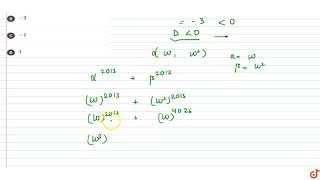
If `alpha and beta` are roots of `x^2-x + 1=0,` then `alpha^2013+beta^2013` is
3:00
If `alpha and beta` are roots of `x^2-x + 1=0,` then `alpha^2013+beta^2013` is
-
 2:19
If in a right angle triangle ABC.`4 sin A cos B -1 =0` and `tan A` is finite, then
2:19
If in a right angle triangle ABC.`4 sin A cos B -1 =0` and `tan A` is finite, then
-
 3:04
If the area of the region bounded by the curves, `y=x^2, y=1/x `and the lines `y=0 and x=t (t
3:04
If the area of the region bounded by the curves, `y=x^2, y=1/x `and the lines `y=0 and x=t (t
-
 7:52
The number of roots of equation `(((x-1)(x-3))/((x-2)(x-4))-e^x)(((x+1)(x+3))/((x+2)(x+4))-e)
7:52
The number of roots of equation `(((x-1)(x-3))/((x-2)(x-4))-e^x)(((x+1)(x+3))/((x+2)(x+4))-e)
-
 5:14
It is given that `[((x+1)^2(x-x+1)^2)/(x^3+1)^2]^-2 xx [((x-1)^2(x^2+x+1)^2)/((x^3-1)^2)]^2-1/
5:14
It is given that `[((x+1)^2(x-x+1)^2)/(x^3+1)^2]^-2 xx [((x-1)^2(x^2+x+1)^2)/((x^3-1)^2)]^2-1/
-
 2:59
`(dy)/(dx)+(3x^2)/(1+x^3)y=(sin^2x)/(1+x^3)`
2:59
`(dy)/(dx)+(3x^2)/(1+x^3)y=(sin^2x)/(1+x^3)`
-
 5:27
Let `f:R- gt(0,pi/6]` be defined as `f(x)=sin^-1(4/(4x^2-12x+17))` then `f(x) ` is
5:27
Let `f:R- gt(0,pi/6]` be defined as `f(x)=sin^-1(4/(4x^2-12x+17))` then `f(x) ` is