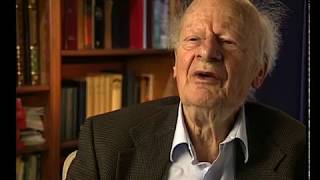
Leonard Hayflick - The history of the Wistar Institute (21/187)
350 views · Published 8 August 2017 · 2:11 · Indexed 20 September 2026
Channel: Web of Stories - Life Stories of Remarkable People · 2017 · Science & Technology
To hear more of Leonard Hayflick’s stories, go to the playlist: https://www.youtube.com/watch?v=yReRalXkFlo&list=PLVV0r6CmEsFyL_YYxHe6RzAARP6eJ_8wC

Born in 1928, Leonard Hayflick is known for his research in cell biology, virus vaccine development, and mycoplasmology. His discovery that human cells divide for a limited number of times in vitro has been named after him as the Hayflick limit. [Listener: Christopher Sykes; date recorded: 2011]

TRANSCRIPT: The Institute was founded by a member of the Wistar family, a very well-known, at least in the 19th century, Philadelphia family, who had some wealth. They had several influential members, one of whom was a General during the Civil War, and they had... they built a substantial library, in addition to which one of the members chose, with enormous foresight, to establish an Institute technically called the Wistar Institute of Anatomy and Biology, which had been built in the 1880s and was the first and oldest biological research institute in the United States. It sits in the middle of the University of Pennsylvania campus, but... and has ties to the university, of course, but it remains independent from the university in respect to management, budget, etc. In order to demonstrate its independence from the institute... from the university, my chief, when I returned many years later, just to give you an idea… humorous aside, would demonstrate his independence, the independence of the institute from the university. The director at that time was Hilary Koprowski, about whom I'll discuss more later. Hilary would pull out a bottle of whisky or claret and pour it for a visitor in order to prove that, unlike the University of Pennsylvania where that is absolutely forbidden and you could probably be sacked for doing it, he was able to do it without fear of any reprisal, because it was an independent institute.
More from this channel
-
 1:32
Murray Gell-Mann - Quarks, mass shell analysis and the bootstrap (102/200)
1:32
Murray Gell-Mann - Quarks, mass shell analysis and the bootstrap (102/200)
-
 1:22
John Maynard Smith - Speculations on the origins of life and Haldane's 3 theorems (102/102)
1:22
John Maynard Smith - Speculations on the origins of life and Haldane's 3 theorems (102/102)
-
 2:00
John Maynard Smith - Experiencing feminism in science (83/102)
2:00
John Maynard Smith - Experiencing feminism in science (83/102)
-
 1:34
Brian Aldiss - Charles Monteith – a kindred spirit (17/79)
1:34
Brian Aldiss - Charles Monteith – a kindred spirit (17/79)
-
 4:00
Hans Bethe - The importance of support for pure science (97/158)
4:00
Hans Bethe - The importance of support for pure science (97/158)
-
 4:06
Hans Bethe - Outbreak of World War II; scientists' efforts (82/158)
4:06
Hans Bethe - Outbreak of World War II; scientists' efforts (82/158)
-
 2:03
Hans Bethe - Short range order vs long range order in the metal alloy (46/158)
2:03
Hans Bethe - Short range order vs long range order in the metal alloy (46/158)
-
 4:15
James Black - Realising a new drug is needed for heart failure (28/33)
4:15
James Black - Realising a new drug is needed for heart failure (28/33)