Momentum (14 of 16) Elastic Collisions, Example 4
3,765 views · Published 26 November 2017 · 5:42 · Indexed 21 October 2026
Channel: Step by Step Science · 2017 · Education
Worked example for momentum and perfectly elastic collisions. Shows how to determine the final velocity of both masses when a mass in motion collides with a second mass that is also in motion in the same direction. Mass 1 is less than mass 2. After the collision each mass has a different final velocity.

This problem uses conservation of momentum and conservation of kinetic energy to determine the final velocities.

In an inelastic collision the objects stick together. Due to deformation of the objects, the release of heat and increased vibrational energy, kinetic energy is not conserved.  Momentum is conserved. In a perfectly elastic collision the objects do not stick together, therefore kinetic energy and momentum are both conserved.

See a listing of all my videos at http://www.stepbystepscience.com

Share this video with the following link: https://youtu.be/-MA8k9v2SPM

Support my YouTube channel by doing all of the following:
(1) Subscribe to my channel.  Get all my excellent physics, chemistry & math videos.
(2) Give this video a thumbs up.
(3) Leave me a nice positive comment for this video.
(4) Sharing is Caring. Sharing is this video with all of your friends.
More from this channel
-
 0:17
Care Bear (Sunshine ) Cannon
-
 9:43
Elimination Method, Systems of Linear Equations, No. 2
-
 8:50
Gravitation (17 of 17 ) Conservation of Mechanical Energy, Final Velocity of a Satellite
-
 5:45
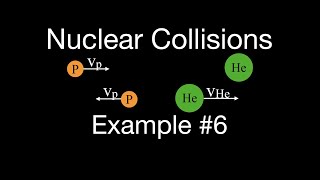
Momentum (16 of 16) Elastic Collisions, Example 6
-
 8:29
Electromagnetic Induction (10 of 15) Induced Emf in a Coil of Wire, Example No. 3, Part 2
-
 0:58
Brian Swarthout Pitch Video