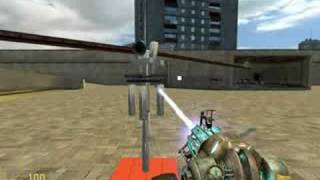
First succesful ornithopter.
1,902 views · Published 9 October 2010 · 3:56 · Indexed 29 October 2026
Channel: RCmags · 2010 · Gaming
This is my first successful craft powered by wing flapping. To produce thrust with an oscillating wing, the angle of attack must remain constant. To do so, at the end of each cycle of the oscillation, the wing must rotate. This assures constant average thrust. Changes in angle of attack are done by equalizing the force between a lever (which is ballsockected to the wing and constrained by two elastics) and drag and lift. Since the blades are hinged in front of the wings aerocenter (point of net lift), they will have a self neutralizing tendency (the will try to have zero angle of attack, similar to a weathervane).

To provide lift paralel to the flapping axis (perpendicular to the body in the video), the angle of attack must be offset. If the wings do not flap, the craft will simply fly as a glider. Once they start flapping during one cycle of the oscillation, the wings (because of their weathervane tendency) will vector some lift forward (because of their flapping and forward speed, and change in angle of attack). This counteracts drag and allows the craft to sustain itself and even climb. The faster the wings flap, the more lift produced thus more thrust (Also increasing the force sustaining the craft, making it climb) and higher airspeed. Starting a new cycle, the preset angle plus the weathervane effect will drastically decrease the angle of attack. During this part of flapping, the wing simply pases through the air without producing any useful lift.