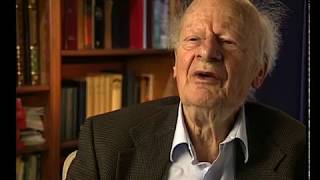
Gerald Edelman - Anosognosia (42/86)
1,325 views · Published 17 July 2017 · 1:51 · Indexed 20 September 2026
Channel: Web of Stories - Life Stories of Remarkable People · 2017 · Science & Technology
To listen to more of Gerald Edelman’s stories, go to the playlist:
https://www.youtube.com/playlist?list=PLVV0r6CmEsFwfn8yTKeVwA9CcyjZphj9f

Biologist Gerald Edelman (1929-2014) was born in America. His early work concentrated on the study of immunology and he was jointly awarded the Nobel Prize in Physiology or Medicine in 1972 for his work leading to the understanding of the antibody’s chemical structure. [Listeners: Ralph J Greenspan; date recorded: 2005]

TRANSCRIPT: Well, there's another kind of disease related to that which is that, if you have a more extensive stroke, you have something called anosognosia, in which you don't even realize that you're paralyzed on your left side. So let me tell you the story of the neuropsychologist and neurologist Bisiach in Milan. We had a patient of this kind who had anosognosia, had a massive stroke on the right side and he came up and he said, 'Look, I've got these two cubes, they're identical; I'm going to put this one in your left hand and will take it in my left hand the other one. Now copy what I've done.' And he moved his hand around. The patient said, 'There, Doc, I've done it.' He said, 'No, you haven't.' He said, 'Sure I have.' He took the patient's hand and put it in his right visual field and said, 'Whose hand is this?' And the patient said, 'Yours.' And he said, 'I can't have three hands.' And the patient said, 'Doc, it stands to reason, if you've got three arms you have to have three hands.'

Now, that theory is a very deep theory that would explain that, and we don't really have that theory yet. It would be almost like what Freud said... would be the equivalent of what he called Anna O – a kind of paradigm case that, if you explain that, you have the whole picture. So the brain is embodied and it depends in its dynamics on the kind of body you have. But the second thing is: the brain and the body are in the world, and the signals that go to your brain, unlike what we do in our laboratories, are enormously diverse and complex. If you came in this room ten times and I changed the chairs or the... the table, you don't really believe that you keep every single detail of the last time in your mind, yet the number and diversity of different kinds of inputs, even at the same place, is absolutely astonishing. So how can you put a brain theory together unless you consider all of these things?
More from this channel
-
 1:32
Murray Gell-Mann - Quarks, mass shell analysis and the bootstrap (102/200)
1:32
Murray Gell-Mann - Quarks, mass shell analysis and the bootstrap (102/200)
-
 1:22
John Maynard Smith - Speculations on the origins of life and Haldane's 3 theorems (102/102)
1:22
John Maynard Smith - Speculations on the origins of life and Haldane's 3 theorems (102/102)
-
 2:00
John Maynard Smith - Experiencing feminism in science (83/102)
2:00
John Maynard Smith - Experiencing feminism in science (83/102)
-
 1:34
Brian Aldiss - Charles Monteith – a kindred spirit (17/79)
1:34
Brian Aldiss - Charles Monteith – a kindred spirit (17/79)
-
 4:00
Hans Bethe - The importance of support for pure science (97/158)
4:00
Hans Bethe - The importance of support for pure science (97/158)
-
 4:06
Hans Bethe - Outbreak of World War II; scientists' efforts (82/158)
4:06
Hans Bethe - Outbreak of World War II; scientists' efforts (82/158)
-
 2:03
Hans Bethe - Short range order vs long range order in the metal alloy (46/158)
2:03
Hans Bethe - Short range order vs long range order in the metal alloy (46/158)
-
 4:15
James Black - Realising a new drug is needed for heart failure (28/33)
4:15
James Black - Realising a new drug is needed for heart failure (28/33)