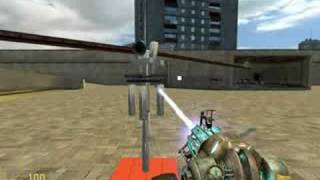
Swashplateless helicopter control.
4,552 views · Published 27 September 2010 · 5:52 · Indexed 29 October 2026
Channel: RCmags · 2010 · Gaming
This helicopter mimics the movement of a swashplate via two high speed solenoids which are connected (via ropes) to the rotor blades pitch/angle of attack axis. To achieve collective (increase lift on both blades) the solenoids deflect in opposite directions, a swashplate does this by moving up and down/vertically on the rotor shaft.

To achieve cyclic (create uneven lift with the blades in a certain position) a beacon sensor is parented to the rotor shaft and linked to a locator on the body. The bearing of the beacon sensor to the locator will give the position of the rotor relative to the body. Sine and cosine of the bearing are then multiplied by the desired cyclic input. This makes a sine/cosine wave timed to the position of the rotor. It can be advanced or delayed by adding or subtracting an angle from the bearing. This is done using an expression 2.

A swashplate does the same by tilting. Having one part rotate with the shaft (this acts as the beacon sensor, giving an angle), and the non-rotating part tilt (multiplying the sine of the said angle by how much it tilts. The wave can be delayed or advanced by tilting the swashplate in a different direction).

The timing of the sine/cosine will change the direction in which the helicopter rolls given cyclic input. Which is why a swashplate tilts in oppositive directions to pitch and roll the helicopter.