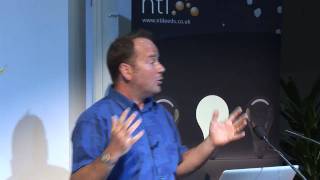
Simple systems? Why complexity matters in emerging disease | Mark Brown | TEDxWoking
927 views · Published 5 February 2015 · 17:25 · Indexed 29 September 2026
Channel: TEDx Talks · 2015 · Nonprofits & Activism
How does people's binary view of the world translate into how we fight emerging disease? How is it helping to understand bees?

Let Mark walk you through how the way in which we construct how we see the world is both beneficial and problematic in scientific discovery.

(From The WWF-UK Living Planet Centre, Woking for TEDxWoking, guest-curated by Sam Marshall and Kate Mair.)

Mark Brown grew up in Warwickshire, and completed his undergraduate degree in Zoology at Oxford University, before completing his PhD on ants at Stanford University in California. He then moved countries, to Switzerland, and study systems, to parasites in bumblebees, as a European Union Post-doctoral Fellow.

After three and a half years in the ‘land of chocolate’, he moved to Ireland to become Lecturer in Zoology at Trinity College Dublin, where he began to develop his interest in the conservation of bees.

In 2008, he moved to Royal Holloway University of London, where he was promoted to a Professorial Chair in 2013.

His work in the UK focuses on the interactions between parasites and bumblebees, the potential threats posed by commercial bumblebees and honeybees to wild pollinators, and the conservation of the UK’s bees.

This talk was given at a TEDx event using the TED conference format but independently organized by a local community. Learn more at http://ted.com/tedx
More from this channel
-
 29:09
Dirk De Boe | TEDxFlanders
29:09
Dirk De Boe | TEDxFlanders
-
 17:00
Time, choice and sustainable development | Dr Daniel Irurah | TEDxJoburgNorth
17:00
Time, choice and sustainable development | Dr Daniel Irurah | TEDxJoburgNorth
-
 1:47
TEDxBoston | Revolutionary Ideas Opening
1:47
TEDxBoston | Revolutionary Ideas Opening
-
 18:29
Slow communication | Stefan Agamanolis | TEDxRegentsPark
18:29
Slow communication | Stefan Agamanolis | TEDxRegentsPark
-
 9:17
Global heroes | Ann Medlock | TEDxPugetSound
9:17
Global heroes | Ann Medlock | TEDxPugetSound
-
 9:12
Saving the planet one house at a time | Donna Shirey | TEDxPugetSound
9:12
Saving the planet one house at a time | Donna Shirey | TEDxPugetSound
-
 31:56
Gaming revolution -- rebuilding a direct relationship with audiences | Charles Cecil | TEDxLeeds
31:56
Gaming revolution -- rebuilding a direct relationship with audiences | Charles Cecil | TEDxLeeds
-
 21:03
Quest for better beer | Jeff Murphy | TEDxMITClubSingapore
21:03
Quest for better beer | Jeff Murphy | TEDxMITClubSingapore