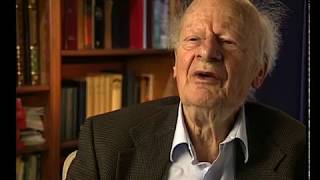
Albert Maysles – Thoughts on art and my parents (1/97)
1,154 views · Published 25 August 2017 · 2:56 · Indexed 20 September 2026
Channel: Web of Stories - Life Stories of Remarkable People · 2017 · Entertainment
To listen to more of Albert Maysles’ stories, go to the playlist: https://www.youtube.com/watch?v=7tqxYdgVwtk&list=PLVV0r6CmEsFwINwqzgi8gYJPFHbxA_7tK

Albert Maysles (1926-2015) was known for his important documentaries on Muhammad Ali, Jimi Hendrix and The Beatles. He pioneered the documentary style known as Direct Cinema and helped create techniques still used in modern documentary production and in reality TV. [Listeners: Sara Maysles, Rebekah Maysles and Tamara Tracz; date recorded: 2004]

TRANSCRIPT: I guess that every work of art, or almost every- every important work of art, I'd say, is autobiographical. That is, whoever is making the film, there's something of his or her own personality that shapes the film if only for the fact that one tends to choose a subject matter, stuff that, even though you may not be aware of it at the time, later on you say oh, oh, yeah, now that I've seen the film, having just finished it, I'm becoming aware that yeah, that person is very much like my father, for example. Certainly that's true in the case of the film "Salesman", but we'll get back to that and other films that I've engaged myself in making over these many years- 50 years now. I'm the son of immigrants. My mother came from Eastern Europe when she was two and my father seven. What was her name? What's that? Their full names. What were their names? My mother's name was Ethel Epstein and she would have preferred that it would be Emma Goldman; that is, Emma, instead of Ethel, but it didn't work out that way. My father was a postal clerk who really should have been a musician. He certainly could play the cornet. And I have his cornet in my possession. My mother was a schoolteacher but she wasn't allowed to practice in Boston where I was brought up because in those days a woman who was married was not allowed to teach in public school, the theory being that somehow that would take away the job from a man who was supposed to be the sole breadwinner. That changed for her when we moved to Brookline just outside of Boston and one of the reasons we moved was that she might find work in Brookline which was an independent town- something like a suburb to Boston. But upon arrival she found out that they had never hired a Jewish teacher so they weren't about to, to hire her. And- but she somehow got an appointment with the superintendent of schools and she managed to become at least a permanent substitute which meant that she didn't get paid for vacations and so forth, and at a lower rate of pay, but at least she had a full year's employment.
More from this channel
-
 1:32
Murray Gell-Mann - Quarks, mass shell analysis and the bootstrap (102/200)
1:32
Murray Gell-Mann - Quarks, mass shell analysis and the bootstrap (102/200)
-
 1:22
John Maynard Smith - Speculations on the origins of life and Haldane's 3 theorems (102/102)
1:22
John Maynard Smith - Speculations on the origins of life and Haldane's 3 theorems (102/102)
-
 2:00
John Maynard Smith - Experiencing feminism in science (83/102)
2:00
John Maynard Smith - Experiencing feminism in science (83/102)
-
 1:34
Brian Aldiss - Charles Monteith – a kindred spirit (17/79)
1:34
Brian Aldiss - Charles Monteith – a kindred spirit (17/79)
-
 4:00
Hans Bethe - The importance of support for pure science (97/158)
4:00
Hans Bethe - The importance of support for pure science (97/158)
-
 4:06
Hans Bethe - Outbreak of World War II; scientists' efforts (82/158)
4:06
Hans Bethe - Outbreak of World War II; scientists' efforts (82/158)
-
 2:03
Hans Bethe - Short range order vs long range order in the metal alloy (46/158)
2:03
Hans Bethe - Short range order vs long range order in the metal alloy (46/158)
-
 4:15
James Black - Realising a new drug is needed for heart failure (28/33)
4:15
James Black - Realising a new drug is needed for heart failure (28/33)