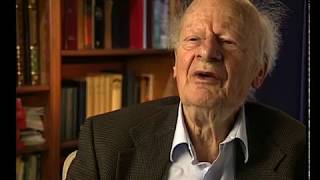
John Maynard Smith - Speculations on the origins of life and Haldane's 3 theorems (102/102)
1,442 views · Published 23 January 2017 · 1:22 · Indexed 20 September 2026
Channel: Web of Stories - Life Stories of Remarkable People · 2017 · Science & Technology
To hear more of John Maynard Smith’s stories, go to the playlist: https://www.youtube.com/watch?v=0b0Nm_L3TKg&list=PLVV0r6CmEsFzJSvAc4MBuUP_GrjO1lLHp

The late British biologist John Maynard Smith (1920-2004) is famous for applying game theory to the study of natural selection. In 1973 Maynard Smith formalised a central concept in game theory called the evolutionarily stable strategy (ESS). His ideas, presented in books such as 'Evolution and the Theory of Games', were enormously influential and led to a more rigorous scientific analysis and understanding of interactions between living things. [Listener: Richard Dawkins; date recorded: 1997]

TRANSCRIPT: At the moment, we just don't know which features of life are like that because of the accidents of common origin and which of them are like that because they have to be. And I know you have speculations about what things have to be, and I do, but it would be nice to have another case of an independent origin of life and see whether our hunches about, for example, inheritance have to be Weismannian rather than Lamarckian, or like, inheritance has to be digital and not analogue, and so on. Are these speculations correct?

[RD] Double our sample size from one to two.

Well, three. Haldane had these three theorems which would enable you to do the whole of science. One was Pangloss's Theorem, which is 'All is for the best, in this best of all possible worlds.' But the one that is relevant to the question you've just asked, was the Bellman's Theorem, which is 'What I've told you three times is true.' The third one, just for completion, was Aunt Jobisca's Theorem, which is a very powerful theorem if you get into an argument; 'It's a fact the whole world knows, that the Pobble is happier without its toes.' And indeed, these theorems do get... three cases would be enough, but actually two would be great. Two would be marvellous.
More from this channel
-
 1:32
Murray Gell-Mann - Quarks, mass shell analysis and the bootstrap (102/200)
1:32
Murray Gell-Mann - Quarks, mass shell analysis and the bootstrap (102/200)
-
 2:00
John Maynard Smith - Experiencing feminism in science (83/102)
2:00
John Maynard Smith - Experiencing feminism in science (83/102)
-
 1:34
Brian Aldiss - Charles Monteith – a kindred spirit (17/79)
1:34
Brian Aldiss - Charles Monteith – a kindred spirit (17/79)
-
 4:00
Hans Bethe - The importance of support for pure science (97/158)
4:00
Hans Bethe - The importance of support for pure science (97/158)
-
 4:06
Hans Bethe - Outbreak of World War II; scientists' efforts (82/158)
4:06
Hans Bethe - Outbreak of World War II; scientists' efforts (82/158)
-
 2:03
Hans Bethe - Short range order vs long range order in the metal alloy (46/158)
2:03
Hans Bethe - Short range order vs long range order in the metal alloy (46/158)
-
 4:15
James Black - Realising a new drug is needed for heart failure (28/33)
4:15
James Black - Realising a new drug is needed for heart failure (28/33)
-
 3:00
Baruch Blumberg - Getting married and continuing with clinical research (14/80)
3:00
Baruch Blumberg - Getting married and continuing with clinical research (14/80)