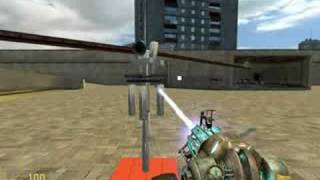
Semi-rigid rotor head. Initial tests.
2,248 views · Published 4 April 2010 · 4:13 · Indexed 29 October 2026
Channel: RCmags · 2010 · Gaming
All previous successful helicopters I have made used a rigid rotor, meaning the blades weren't allowed to flap up and down lengthwise (although there is some flexing of the rotor, it is too little). This means that most of the forces acting on that axis of the blade get directly transferred to the shaft, and thus the airframe.  This means that any small uneven forces in the blades go directly into vibrations. During lateral flight, dissymmetry of lift causes extreme torque upon the airframe given certain conditions, although this can be corrected with cyclic, controlling the craft is not pleasant.

Allowing the blades to flap in unison means that uneven forces act mostly on the blades and not the airframe (decreasing vibrations drastically), it also allows the uneven forces experienced during forward flight to go into flapping the blades (tilting the rotor disk) and do not affect the airframe. This is a great improvement over a rigid design. Cyclic control is slightly less effective though.

Another major advantage is the fact that there is very little load on the swashplate now. Unlike a rigid rotor where the swashplate has to carry much more load.