3. Ahern's BB 350 at Oregon State University - Water & Buffers II
2,489 views · Published 9 April 2017 · 46:29 · Indexed 24 October 2026
Channel: Kevin Ahern's YouTube Videos - Lectures and More · 2017 · Education
1. Contact - [email protected]
2. Kevin's lectures with The Great Courses - https://www.thegreatcoursesplus.com/biochemistry-and-molecular-biology-how-life-works?tn=Expert_tray_Course_1_0_12943
3.  Kevin's Lecturio videos for medical students - https://www.lecturio.com/medical-courses/biochemistry.course
4. Course materials at https://kevingahern.com/biochemistry-resources/
5. Course video channel at https://www.youtube.com/watch?v=JSntf0iKMfM&list=PLlnFrNM93wqz37TUabcXFSNX2nJtrJnkx
6.  Metabolic Melodies at https://teeheetime.com/category/lyrics-science/
7.  Kevin's Free Biochemistry books - https://kevingahern.com/biochemistry-resources/
8.  Kevin's Pre-med Audio course on Listenable - https://listenable.io/web/courses/143/kevin-aherns-guide-to-getting-into-medical-school/

Highlights Buffers

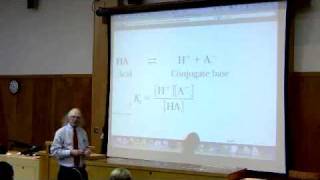
1. A buffer is a solution containing a weak acd and its salt that resists changes in pH. Remember that pH is a measure of the concentration of hydrogen ions (pH = -log[H+]), so the addition or subtraction of hydrogen ions to a buffer solution has a smaller effect on the pH than the addition or subtraction of hydrogen ions to a solution of pure water.

2. Buffers act by providing protons to replace the lost protons when a strong base is added (by HA releasing H+) to replace the protons lost by forming water or by absorbing the protons added from a strong acid, like HCl. In the latter case, A- absorbs the H+ to become HA.

3. This is important - for every proton added by a strong acid, one HA is created by the buffer and one A- is lost. Conversely, for every proton removed by NaOH, one A- is created and one HA is lost. If this is not clear to you, please come to see me.

4. When the amount of salt equals the amount of acid in the Henderson-Hasselbalch equation, the log term equals zero. Thus, when salt = acid for a buffer, pH = pKa. When the pH is less than the pKa, there will be more acid than salt. When the pH is greater than the pKa, there will be more salt than acid.

5. Note for a buffer that when [salt] = [acid], the maximum capacity of the buffer is reached. That is, at this point, the buffer will resist changes in pH greater than at any other point.

6. Buffers are effective when the pH of the solution in which they are found is within about 1 pH unit of the pKa of that buffer.

7. Proteins have optimal activity at fairly specific pHs. For example, pepsin, which is an enzyme that is active in stomach (where there is a low pH, due to a lot of acid) has a maximal ability to catalyze reactions at about the pH of stomach acid. Most enzymes have their maximal ability to catalyze reactions at around the pH of body fluids - about 7.4.
More from this channel
-
 0:56
When Acids are Oxidized
-
 0:30
How to do "The Wiggle", part 2
-
 0:18
How to Do "The Wiggle", part 1
-
 14:52
Water, Acids, and Buffers in Biochemistry by Kevin Ahern, Part 5 of 8
-
 14:51
Water, Acids, and Buffers in Biochemistry by Kevin Ahern, Part 3 of 8
-
 14:41
Amino Acid Structure and Charge by Kevin Ahern, Part 1 of 4
-
 14:31
Amino Acid Structure and Charge by Kevin Ahern, Part 2 of 4
-
 14:44
Protein Structure and Function by Kevin Ahern, Part 5 of 8