See and Avoid - How light aircraft avoid collisions.
4,009 views · Published 1 October 2015 · 7:54 · Indexed 23 October 2026
Channel: The Flying Reporter · 2015 · People & Blogs
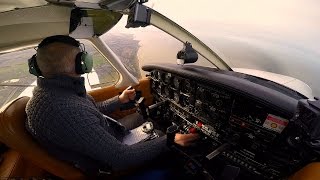
When flying light aircraft, in uncontrolled airspace, mid-air collisions are primarily not avoided by instructions from radar controllers, or by using sophisticated cockpit equipment.  Instead, pilots avoid collisions by using their eyes..a concept called 'see and avoid'.  In this short video, I demonstrate how I responded to two mid-air collision risks quickly and effectively during one autumn flight in South East England. In both cases I was at the time in receipt of a Basic Service from ATC.

The video isn't very good at showing how close both aircraft were.  They look like tiny specs in the distance.  But, certainly in the first example, the aircraft was on a converging course, probably at a closing speed of 150knots or more, and was just a few seconds from an airprox/air-miss.

In that first case, just north of Brighton, the aircraft was converging from the left, first spotted a few hundred metres away.  From my perspective, the aircraft wasn't moving in my line of vision, and was just growing bigger in the window.  I reacted at first sight, knowing that we were in danger of a collision, in spite of me having right of way.  I conducted a steep descending turn to the right, dropping 500ft in a few seconds.  The other aircraft passed above my left wing and behind me.

In the second case, which occurred about 15 minutes later, 2nm or so south west of the MAY VOR, the aircraft was on course to just overtake me on the left and was closing quite fast.  Again, I had right of way, but turned right.

Even though, in both cases I had right of way, I suspect both aircraft hadn't yet seen me, and so I took decisive action.  The act of turning away in both cases, will have made my aircraft more visible to the other.

Incidents such as this are not uncommon in uncontrolled airspace  in and around Gatwick, City and Heathrow, since light aircraft are sandwiched in a narrow band of airspace below controlled airspace between 2500ft, and minimum safe altitudes of 1500-1900 ft.  This video concludes with lovely autumn views of Brighton from 2000ft, and a crosswind landing onto Biggin Hill's 03 runway.
More from this channel
-
 6:33
Flying - Biggin - Lydd - Biggin highlights
-
 4:22
Flying around Kent October 2014
-
 6:30
Take off and landing at Lydd Aerodrome.
-
 53:06
Short flight Elstree to Biggin Hill
-
 7:01
Biggin to Elstree Highlights
-
 15:31
PA28 flight around Kent.
-
 4:54
Dungeness Lifeboat Launch, BBC News
-
 6:56
PA28 Biggin Hill, East Kent tour