3903Grafts. HT by FUE Technique. Diffuse DPA II vertex.Injertocapilar.com.1521/2016.
997 views · Published 20 April 2018 · 4:00 · Indexed 27 October 2026
Channel: Injertocapilar España · 2018 · Science & Technology
Website: https://injertocapilar.com (Español);https://injertocapilar.com/?lang=en (English)
Questionnaire: https://injertocapilar.com/diagnostico-online/(SP) https://injertocapilar.com/online-diagnosis-2/?lang=en (EN)
- Paciente visto por primera vez en consulta en 2010 con 34 años, se prescribe sólo tratamiento médico y control.

 Cinco años después y ya con 39 años se decide realizar un pequeño retoque para reforzar entradas y coronilla.

 A tal fin se extraen 2002 grafts (700 entradas, 1300 coronilla a 2,59 pelos /graft (5179 pelos; 50 a 55 micras de pelo; 0.7-0.8 mm punch; 198G1; 691G2; 867G3; 232G4; 14G5).

 Satisfactorio resultado de las zonas tratadas al año de la cirugía, pero se decide nuevamente bajar mínimamente la línea frontal y reforzar toda la raya del medio dado que su peinado natural va con raya al medio. Dado que el paciente posee una alopecia mínima para su edad, estable y controlada médicamente, se procede a realizar la segunda intervención sabiendo la complicación que conlleva injertar entre pelo nativo.

La zona donante en esta segunda intervención presenta las siguientes características:

· Temporal: 52 micras de pelo; 106 UF/cm2; 213 pelos/cm2; 2,01 pelos/UF; CV de 11,08

· Parietal: 54 micras; 101 UF/cm2; 232 pelos/cm2; 2,30 pelos/UF; CV de 12,53

· Occipital: 56 micras; 100 UF/cm2; 225 pelos/cm2; 2,25 pelos/UF; CV de 12,60

TDA (área donante total) de 226 cm2  y TDC (capacidad donante total) de 12748 grafts (a 2,19 pelos/graft).

Se realiza intervención de 1901 grafts (4551 pelos) para restaurar 36 cm2 de frontal (1300 grafts), y 37 cm2 de línea media, con una densidad real medida de 48 grafts/cm2 en el frontal, y una media de 2,39 pelos/graft (272 singles; 743 dobles; 756 triples; 125 cuadruples, 5 quíntuples). Punch de 0.8mm.

El video muestra la evolución y crecimiento a los 7 meses.

The first time we seen this patient in consultation was 2010 with 34 years, and only medical treatment was prescribed. Five years later and now with 39 years we both decided to make a touch-up to strengthen the corners and crown.

So we extracted 2002 grafts (700 frontal, 1300 crown) at 2.59 hairs/graft (5179 hairs, 50 to 55 micron of hair caliber, 0.7-0.8 mm punch; 198G1; 691G2; 867G3; 232G4; 14G5).

Nice result in the treated areas after one year, but we again planned to minimally lower frontal hair line and reinforce all the mid line since his natural hairstyle goes with the line in the middle. Given that the patient has a minimum stable alopecia at his age, and medically controlled, we proceed, 15 months after, to make a second procedure knowing the complication involved grafting between native hair.

The donor area in this second surgery as follow:

· Temp: 52 microns of hair; 106 FU/cm2; 213 hairs/cm2; 2,01 hairs/FU; CV 11.08

· Parietal: 54 microns; 101 FU/cm2232 hairs/cm2; 2,30 hairs/FU; CV 12,53

· Occipital: 56 microns; 100 FU/cm2; 225 hairs/cm2; 2,25 hairs/FU; CV 12,60

TDA (total donor area) of 226 cm2  and TDC (total donor capacity) of 12748 grafts (at 2,19 hairs/graft).

We carried out a new 1901 grafts procedure (4551 hairs) to restore 36 cm2 in frontal area (1300 grafts), and 37 cm2 on mid line, with a real density of 48 grafts/cm2 in the very first line, at and average of 2,39 hairs/graft (272 singles; 743 dobles; 756 triples; 125 cuadruples, 5 quíntuples). Punch of 0.8mm.

Video shows the evolution and regrowth at 7 months.

Dr. José Lorenzo. www.injertocapilar.com. Madrid. Spain.
More from this channel
-
 3:18
6558 FU's. Hair Transplant by FUE Technique. Advanced Alopecia. Injertocapilar.com. 314/2010
-
 3:16
1551 FU's. Hair Transplant by FUE Technique. Injertocapilar.com. 855/2012
-
 3:07
2353 FU's. Hair Transplant by FUE Technique. Injertocapilar.com. 824/2012
-
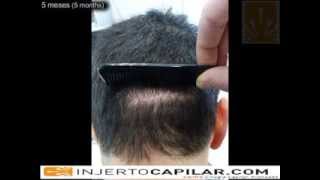 1:24
Scar Repair. Hair Transplant by FUE Technique. Injertocapilar.com. 820/2012
-
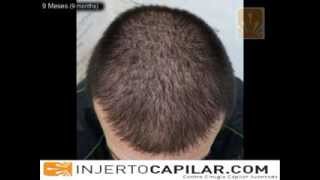 4:05
1802 FU's. Hair Transplant by FUE Technique. Shaved HT. Injertocapilar.com. 765/2012
-
 2:26
2801 FU's. Hair Transplant by FUE Technique. Injertocapilar.com. 739/2012
-
 2:58
2301 FU's. Hair Transplant by FUE Technique. Scar Repair. Injertocapilar.com. 736/2012
-
 2:39
1752 FU's. Hair Transplant by FUE Technique. Shaved HT. Injertocapilar.com. 688/2012