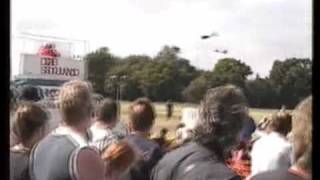
HAWKER HURRICANE & SUPERMARINE SPITFIRE DISPLAY AT BIGGIN HILL FESTIVAL OF FLIGHT UK - 2016
4,766 views · Published 9 March 2017 · 10:12 · Indexed 30 October 2026
Channel: tbobborap1 · 2017 · Science & Technology
CHECK OUT OUR PLAYLIST OF OVER TEN VIDEOS FROM THE BIGGIN HILL FESTIVAL OF FLIGHT - 2016 - HERE

 https://www.youtube.com/watch?v=E9HhPZmLYyo&list=PLnnDxY-6mwEGd_RjuKU8Qyvrirgzlg4OH

HAWKER HURRICANE
Role - Fighter
National origin - United Kingdom
Manufacturer - Hawker Aircraft
Designer - Sydney Camm
First flight - 6 November 1935
Introduction - 25 December 1937[1]
Primary users -
Royal Air Force
Royal Canadian Air Force
Produced - 1937–1944
Number built - 14,584

SUPERMARINE SPITFIRE

Role - Fighter / Photo-reconnaissance aircraft
National origin - United Kingdom
Manufacturer - Supermarine
Designer - R. J. Mitchell
First flight - 5 March 1936
Introduction - 4 August 1938
Retired - 1961 Irish Air Corps
Primary users -
Royal Air Force
Royal Canadian Air Force
United States Army Air Forces
Produced - 1938–1948
Number built - 20,351
Unit cost - £12,604 (Estonian order for 12 Spitfires in 1939)
Variants
Supermarine Seafire
Supermarine Spiteful

HAWKER HURRICANE -

The Hawker Hurricane is a British single-seat fighter aircraft of the 1930s-1940s that was designed and predominantly built by Hawker Aircraft Ltd for the Royal Air Force (RAF). Although overshadowed by the Supermarine Spitfire, the aircraft became renowned during the Battle of Britain, accounting for 60% of the RAF's air victories in the battle, and served in all the major theatres of the Second World War.
The 1930s design evolved through several versions and adaptations, resulting in a series of aircraft which acted as fighters, bomber-interceptors, fighter-bombers (also called "Hurribombers") and ground support aircraft. Further versions known as the Sea Hurricane had modifications which enabled operation from ships.
Some were converted as catapult-launched convoy escorts, known as "Hurricats". More than 14,583 Hurricanes were built by the end of 1944 (including at least 800 converted to Sea Hurricanes and some 1,400 built in Canada by Canadian Car and Foundry).

SUPERMARINE SPITFIRE

The Supermarine Spitfire is a British single-seat fighter aircraft that was used by the Royal Air Force and many other Allied countries before, during and after World War II. The Spitfire was built in many variants, using several wing configurations, and was produced in greater numbers than any other British aircraft. It was also the only British fighter to be in continuous production throughout the war. The Spitfire continues to be popular among enthusiasts; about 54 remain airworthy, while many more are static exhibits in aviation museums throughout the world.
The Spitfire was designed as a short-range, high-performance interceptor aircraft by R. J. Mitchell, chief designer at Supermarine Aviation Works, which operated as a subsidiary of Vickers-Armstrong from 1928. Mitchell pushed the Spitfire's distinctive elliptical wing (designed by B. Shenstone) to have the thinnest possible cross-section, helping give the aircraft a higher top speed than several contemporary fighters, including the Hawker Hurricane.
Mitchell continued to refine the design until his death in 1937, whereupon his colleague Joseph Smith took over as chief designer, overseeing the development of the Spitfire through its multitude of variants.
During the Battle of Britain, from July to October 1940, the Spitfire was perceived by the public to be the main RAF fighter, though the more numerous Hawker Hurricane shouldered a greater proportion of the burden against the Nazi German air force, the Luftwaffe. Spitfire units, however, had a lower attrition rate and a higher victory-to-loss ratio than those flying Hurricanes because of its higher performance.
Spitfires in general were tasked with engaging Luftwaffe fighters (mainly Messerschmitt Bf 109E series aircraft which were a close match for the Spitfire) during the Battle.
After the Battle of Britain, the Spitfire superseded the Hurricane to become the backbone of RAF Fighter Command, and saw action in the European, Mediterranean, Pacific and the South-East Asian theatres,

PLEASE LIKE US ON FACEBOOK AND SUBSCRIBE TO OUR CHANNEL TBOBBORAP1 AND FOLLOW US ON TWITTER NOW AND KEEP UP TO DATE AND WATCH OUR HD QUALITY RC MODELS VIDEOS AND PICTURE UPDATES OF THE MAJOR UK RC SHOWS AND CLUB FLY-INS  AT -

https://www.facebook.com/pages/Tbobborap1/1483073475269714

https://twitter.com/TBOBBORAP1

https://www.youtube.com/user/tbobborap1

FILMED AT THE BIGGIN HILL FESTIVAL OF FLIGHT AT
CHURCHILL WAY,  BIGGIN HILL,  UK,  TN16 3BN,
ON 11-6-2016,
More from this channel
-
 3:52
FLYING IN THE SNOW AT THE PATCH AT HDMFC. ( FPV AIRBORNE VIDEO )
-
 6:43
SNOW ON THE PATCH AT HDMFC ( FPV AIRBORNE VIDEO )
-
 5:16
ALPHA MODELS MIG 15 GUN CAMERA - MIG ALLEY AT HDMFC ( FPV AIRBORNE VIDEO )
-
 5:55
GIANT SCALE RC HANDLEY PAGE VICTOR BOMBER AT ROUGHAM RC SHOW - 2003
-
 7:26
HOP FARM RC PLANES - 2007 - CESSNA , HAWK , PANTHERS .
-
 5:55
ROBIN FLYING HIS GOLDCAT 54 AT HDMFC
-
 4:32
MARK HINTONS F104 STARFIGHTER AT ROUGHAM RC PLANES - 2010
-
 8:38
LMA DAWN PATROL AT ROUGHAM RC PLANES - 2010 ( PART 2 )