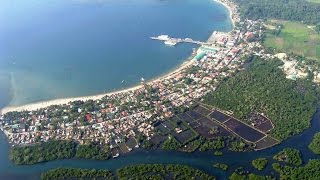
Quelimane, seaport city in Mozambique, trade in tea, sisal, coconuts
1,763 views · Published 4 April 2018 · 0:50 · Indexed 10 November 2026
Channel: Cities of the World · 2018 · Travel & Events
Quelimane

Quelimane (Portuguese pronunciation: [keliˈmani]) is a seaport in Mozambique. It is the administrative capital of the Zambezia Province and the province's largest city, and stands 25 km (16 mi) from the mouth of the Rio dos Bons Sinais (or "River of the Good Signs"). The river was named when Vasco da Gama, on his way to India, reached it and saw "good signs" that he was on the right path. The town was the end point of David Livingstone's west-to-east crossing of south-central Africa in 1856. Portuguese is the official language of Mozambique, and many residents of the areas surrounding Quelimane speak Portuguese. The most common local language is Chuabo. Quelimane, along with much of Zambezia Province, is extremely prone to floods during Mozambique's rainy season. The most recent bout of severe flooding took place in January 2007.An mystery fever is striking down people - mainly children - in the port city of Quelimane, Mozambique.

Health authorities are struggling to identify the malaria-like illness, which includes high fever, joint pain and headaches.

Dulce Santana told reporters it was not the first time she had brought her two year old in In the 16th century, the Portuguese founded a trading station at Quelimane, and until 1853 trade was forbidden to any other than Portuguese.[2] Sisal plantations were organized by German planters in the beginning of the 20th century. The town started to grow and attracted several communities from different backgrounds, including Muslims and Indians, and new infrastructure was built by the Portuguese authorities. Its busy port had tea, grown and processed in the district of Zambézia (particularly important in the region around Gurúè, former Vila Junqueiro), as its major export. Coconut was also produced and transformed in the city.[3] By 1970, Quelimane, Portuguese Mozambique, had 71,786 inhabitants.
After independence from Portugal[edit]
Mozambique became independent from Portugal in 1975, after the April 1974 Carnation Revolution at Lisbon. Although its location on the Rio dos Bons Sinais is less important today than in the past, Quelimane remains a major town with a large hospital, two cathedrals, a mosque, and a public university for teachers. Due to its heat, humidity, and distance from the beach, Quelimane is not among Mozambique's major tourist destinations. However, its status as a provincial capital and the fourth-largest city in Mozambique and the increasing ease of access by plane (Linhas Aéreas de Moçambique runs flights) and road cfor treatment.

"I don’t know the kind of fever she is suffering from," she said.

"I’m not sure whether it is malaria or not. This is not the first time my daughter suffers from the same illness. When she takes medical examinations, nothing is diagnosed. This is frequent.”

Quelimane's chief medical doctor, Joaria Amisse, said they were investigating the issue.

“Patients have, indeed, complained of fevers. We are going to the ground to investigate the problem," he said.
In the 16th century, the Portuguese founded a trading station at Quelimane, and until 1853 trade was forbidden to any other than Portuguese.[2] Sisal plantations were organized by German planters in the beginning of the 20th century. The town started to grow and attracted several communities from different backgrounds, including Muslims and Indians, and new infrastructure was built by the Portuguese authorities. Its busy port had tea, grown and processed in the district of Zambézia (particularly important in the region around Gurúè, former Vila Junqueiro), as its major export. Coconut was also produced and transformed in the city.[3] By 1970, Quelimane, Portuguese Mozambique, had 71,786 inhabitants.
After independence from Portugal[edit]
Mozambique became independent from Portugal in 1975, after the April 1974 Carnation Revolution at Lisbon. Although its location on the Rio dos Bons Sinais is less important today than in the past, Quelimane remains a major town with a large hospital, two cathedrals, a mosque, and a public university for teachers. Due to its heat, humidity, and distance from the beach, Quelimane is not among Mozambique's major tourist destinations. However, its status as a provincial capital and the fourth-largest city in Mozambique and the increasing ease of access by plane (Linhas Aéreas de Moçambique runs flights) and road c
"We are open to clarify any kind of health problem. The current situation caught us by surprise. But, i
More from this channel
-
 1:47
Woroneż to piękne miasto w Rosji, Woroneż rzeki Don, kolej,
-
 1:43
Sorsogon City, bandar indah Filipina, sebelum taufan Melor datang dengan angin, hujan dan banjir.
-
 2:17
Воронеж е красив град в Русия, River Воронеж, Don, железопътен,
-
 2:28
Bujumbura, hermosa ciudad en Burundi, en la orilla del lago Tanganyika, café, mineral de estaño,
-
 2:31
Bujumbura, no Burundi bela cidade, na margem do Lago Tanganyika, café,
-
 2:33
Бужумбура, красивый город в Бурунди, на берегу озера Танганьика, кофе, оловянной руды, медь
-
 2:56
الإسكندرية، مدينة جميلة في مصر، وعلى طول ساحل البحر الأبيض المتوسط، على دلتا النيل.
-
 2:59
Александрия, красивый город в Египте, на побережье Средиземного моря, в дельте Нила.