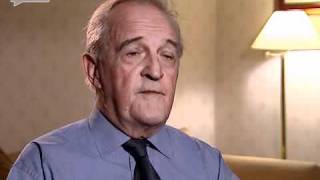
Aleksander Smolar - Establishing boundaries with George Soros (195/201)
338 views · Published 20 December 2018 · 5:11 · Indexed 30 September 2026
Channel: Web of Stories - Life Stories of Remarkable People · 2018 · News & Politics
To listen to more of Aleksander Smolar’s stories, go to the playlist: https://www.youtube.com/playlist?list=PLVV0r6CmEsFwlxPLurqAOCrabBgGrqLA7

Aleksander Smolar (b. 1940) is a Polish writer, political activist and adviser, vice-president of the Institute for Human Sciences and president of the Stefan Batory Foundation. [Listener: Vitek Tracz]

TRANSCRIPT: [Soros] told me that the first head of this foundation had been Zbyszek Bujak, a great workers' activist during what was still the time of Solidarność. He was the first one after the change in '89. And he said, 'You know', this was Soros telling me and I never repeated this to Zbyszek Bujak nor asked him about it, 'when I met him for the first time, he said: you give me the money but after that, don't ever interfere in any of our decisions'. That was literally how he put it. And Soros said, 'I was a bit taken aback by this because I don't give money, I didn't want anything and I had said nothing, I hadn't had the chance to get involved or to say anything yet he was speaking to me in that tone and that manner which I found surprising'. But Soros had an undeniable fondness for Zbyszek Bujak because he had something of the leftist in him, there was no doubt about that. And he has that to this day. It's for this reason that the right-wingers despise him, everywhere the right wing despises him.

I obviously didn't speak to him in that way, but I did follow the same line that Zbyszek Bujak had laid down regarding total autonomy. The statute was drafted as was the aim which mattered most to Soros: to have an open society. He took this from Popper – democracy, liberalism, political pluralism, pluralism of information, pluralism in public debates and so on. Equal rights for women and for all other possible groups. Beyond this, I absolutely did not allow any interference although there were some who tried to get involved. They were the various leaders of programmes [Soros] had set up who thought they knew better; there was a kind of paternalism. Or else they had advisors who were often very eminent and would try to impose some kind of programme on us. I adamantly refused to let that happen, occasionally on principle. For instance, Metadonton was publicising ways of combatting drug abuse or even the acceptance of soft drugs and [Soros] wanted us to run a programme but I said we wouldn't. Why? Not on principle, I said, because I'm prepared to accept that this is appropriate, but we were concerned with reaching out to the Catholic element and I didn't want to antagonise a large part of the population which was crucial for the growth of democracy in Poland, among Polish society. A separate foundation could be set up which could finance this. We wouldn't concern ourselves with this issue. There were several run-ins like this even during the debates we had. I could see that this would often really rile him but at the same time, he was incredibly liberal, truly liberal and tolerant so he'd listen to all of this. He'd listen and he'd accept it although the consequences were such that he told one foundation when there was conflict there, 'If you do what you want you'll be like the Polish foundation which is one of the smallest and I give them little money'. It was obvious to me that our foundation was relatively small since he felt – and this had filtered down to me – that we wanted to be completely independent of him and even to break our ties with him which was absurd. We repeatedly showed that our actions in the world of his foundation were constructive and that the role we were playing was positive. In several of his books he himself comments that there was conflict but that it turned out that Alik – or Smolar, I can't remember which name he used – had been right. I mean, he admitted to this but in a sense it was after the event namely, once his interest in these foundations had begun to wane. This coincided with our joining the European Union as he believed that now, Europe could pay and he began to pull out of Central-Eastern Europe, although he kept his involvement in the Ukraine and Russia. His institution was later expelled from Russia. Later there were the Arab States, Africa and the United States where he became increasingly more active. In the Unites States themselves… unfortunately, they withdrew from our countries. To this day, we receive some donations for specific programmes, but this in no way compares with what we were receiving then. I see him still, but very occasionally.
More from this channel
-
 0:44
David Weatherall - Entering medical school
0:44
David Weatherall - Entering medical school
-
 2:22
Baruch Blumberg - The link between some cancers and viruses
2:22
Baruch Blumberg - The link between some cancers and viruses
-
 2:26
Marek Edelman - Different criteria for measuring the value of human life
2:26
Marek Edelman - Different criteria for measuring the value of human life
-
 2:45
Jules Engel - So who is responsible for a great animation?
2:45
Jules Engel - So who is responsible for a great animation?
-
 5:02
Eugene Garfield - Retractions in citations
5:02
Eugene Garfield - Retractions in citations
-
 3:08
Russell Fernald - Advice for young scientists: 'The fear of doing anything unconventional'
3:08
Russell Fernald - Advice for young scientists: 'The fear of doing anything unconventional'
-
 2:30
Donald Knuth - Honorary doctorates (86/97)
2:30
Donald Knuth - Honorary doctorates (86/97)
-
 5:14
Donald Knuth - Writing a book about the Bible: "3:16" (72/97)
5:14
Donald Knuth - Writing a book about the Bible: "3:16" (72/97)