bodgit and leggit garage car front pads and discs remove-install
1,033 views · Published 13 May 2014 · 16:14 · Indexed 25 September 2026
Channel: bodgit and leggit garage · 2014 · People & Blogs
bodgit and leggit garage

how to do front pads and discs nissan primera remove-install

tips and tricks inside your video hopefully help you

how to free out seized studs
don't forget get your hands dirty

http://astore.amazon.co.uk/youtube052...
http://astore.amazon.com/youtube0149-20

Brake pads convert the kinetic energy of the car to thermal energy by friction. Two brake pads are contained in the brake caliper with their friction surfaces facing the rotor.[1] When the brakes are hydraulically applied, the caliper clamps or squeezes the two pads together into the spinning rotor to slow/stop the vehicle. When a brake pad is heated by contact with a rotor, it transfers small amounts of friction material to the disc, turning it dull gray. The brake pad and disc (both now with friction material), then "stick" to each other, providing the friction that stops the vehicle.

A disc brake is a wheel brake which slows rotation of the wheel by the friction caused by pushing brake pads against a brake disc with a set of calipers. The brake disc (or rotor in American English) is usually made of cast iron, but may in some cases be made of composites such as reinforced carbon--carbon or ceramic matrix composites. This is connected to the wheel and/or the axle. To stop the wheel, friction material in the form of brake pads, mounted on a device called a brake caliper, is forced mechanically, hydraulically, pneumatically, or electromagnetically against both sides of the disc. Friction causes the disc and attached wheel to slow or stop. Brakes convert motion to heat, and if the brakes get too hot, they become less effective, a phenomenon known as brake fade.


On automobiles, disc brakes are often located within the wheel


motorbike disc brake of Kawasaki W800
The development and use of disc-type brakes began in England in the 1890s. The first caliper-type automobile disc brake was patented by Frederick William Lanchester in his Birmingham, UK factory in 1902 and used successfully on Lanchester cars. Compared to drum brakes, disc brakes offer better stopping performance, because the disc is more readily cooled. As a consequence, disc brakes are less prone to brake fade, and disc brakes recover more quickly from immersion (wet brakes are less effective). Most drum brake designs have at least one leading shoe, which gives a servo-effect. By contrast, a disc brake has no self-servo effect and its braking force is always proportional to the pressure placed on the brake pad by the braking system via any brake servo, braking pedal or lever. This tends to give the driver better "feel" to avoid impending lockup. Drums are also prone to "bell mouthing", and trap worn lining material within the assembly, both causes of various braking problems
More from this channel
-
 6:24
bodgit and leggit garage generator will not start how to start
6:24
bodgit and leggit garage generator will not start how to start
-
 43:54
Bodgit and Leggit Garage PS3 Repair Yellow Light & Blinking Red Light
43:54
Bodgit and Leggit Garage PS3 Repair Yellow Light & Blinking Red Light
-
 6:35
bodgit and leggit garage how to fix a car bubble for FREE
6:35
bodgit and leggit garage how to fix a car bubble for FREE
-
 14:32
bodgit and leggit garage advice and tits for doing clutches
14:32
bodgit and leggit garage advice and tits for doing clutches
-
 2:22
bodgit and leggit garage TNT #3 electrics in door car
2:22
bodgit and leggit garage TNT #3 electrics in door car
-
 21:11
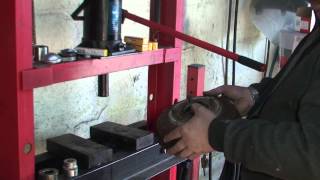
bodgit and leggit garage how to put in a back wheel bearing
21:11
bodgit and leggit garage how to put in a back wheel bearing
-
 10:36
bodgit and leggit garage toyota engine 1 4 vvit removal (part 3)
10:36
bodgit and leggit garage toyota engine 1 4 vvit removal (part 3)
-
 4:04
bodgit and leggit garage how to know when you have a warped disc
4:04
bodgit and leggit garage how to know when you have a warped disc