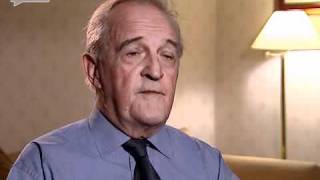
Aleksander Smolar - Schooldays and school friends (88/201)
95 views · Published 18 December 2018 · 3:37 · Indexed 30 September 2026
Channel: Web of Stories - Life Stories of Remarkable People · 2018 · News & Politics
To listen to more of Aleksander Smolar’s stories, go to the playlist: https://www.youtube.com/playlist?list=PLVV0r6CmEsFwlxPLurqAOCrabBgGrqLA7

Aleksander Smolar (b. 1940) is a Polish writer, political activist and adviser, vice-president of the Institute for Human Sciences and president of the Stefan Batory Foundation. [Listener: Vitek Tracz]

TRANSCRIPT: [VT] Did you walk to school?

Yes, it was nearby. In the beginning, we lived very close by, I could walk, but later, no – I took the tram. I remember – today, it’s difficult… older people will remember – the trams festooned with people like bunches of grapes who were hanging on to the step by the open doors – it was fairly dangerous and that’s how I would often travel on my way to school. This was how I’d get to Konopacka Street, I think to Szeroka Street. To be honest, I only have a very vague memory of… I don’t remember the names of these streets. In that school which wasn’t a religious school at all but in its grounds, in the yard, there were the ruins of a synagogue and also, once a year for the festival of Succoth that’s where they built a small shelter, a little house where a religious Jew or a rabbi, I don’t know – my ignorance is vast to this day – in any event, it was fascinating to watch him praying there, swaying back and forth over the Talmud as he prayed. Those are my only religious memories, very external, symbolically very external, that little house.

I had a friend there, well, friends, I remember there was one – my best friend was Jurek Bitter. He was terribly spoiled, very delicate, very intelligent and very sensitive. He became a painter and lives somewhere in the States. But my strongest… I had a very ambivalent relationship with him because it stemmed a bit from his narcissism, his softness and that we were the total opposite in terms of our characters and our psyches. But my strongest memory is of our parting. He left Poland after ’56 – it was ’57 or maybe ’58 – we were talking about his departure and he asked me if I’d leave. I said, ‘No’. He said to me, ‘You can stay here, you’re thick-skinned enough for that’. That hurt me. He was my friend, we had a fairly complex relationship, quite ambivalent, but I’ll never forget that sentence. I accepted that in some sense it was true. Of course the word ‘thick-skinned’ is a negative description, but I knew it meant I was stronger, harder, more able to withstand all kinds of things including those aspects of the Polish situation which inclined people to leave in successive waves. In some sense, not giving in was one of these… one of these personality traits which I valued and which I aimed to achieve – I remember that this was very much the direction that my father’s influence was taking me, in fact, the influence of both my parents.
More from this channel
-
 0:44
David Weatherall - Entering medical school
0:44
David Weatherall - Entering medical school
-
 2:22
Baruch Blumberg - The link between some cancers and viruses
2:22
Baruch Blumberg - The link between some cancers and viruses
-
 2:26
Marek Edelman - Different criteria for measuring the value of human life
2:26
Marek Edelman - Different criteria for measuring the value of human life
-
 2:45
Jules Engel - So who is responsible for a great animation?
2:45
Jules Engel - So who is responsible for a great animation?
-
 5:02
Eugene Garfield - Retractions in citations
5:02
Eugene Garfield - Retractions in citations
-
 3:08
Russell Fernald - Advice for young scientists: 'The fear of doing anything unconventional'
3:08
Russell Fernald - Advice for young scientists: 'The fear of doing anything unconventional'
-
 2:30
Donald Knuth - Honorary doctorates (86/97)
2:30
Donald Knuth - Honorary doctorates (86/97)
-
 5:14
Donald Knuth - Writing a book about the Bible: "3:16" (72/97)
5:14
Donald Knuth - Writing a book about the Bible: "3:16" (72/97)