Donald Knuth - Being creative in the forest (36/97)
3,019 views · Published 11 February 2016 · 6:04 · Indexed 25 September 2026
Channel: Web of Stories - Life Stories of Remarkable People · 2016 · Science & Technology
To listen to more of Donald Knuth’s stories, go to the playlist: https://www.youtube.com/playlist?list=PLVV0r6CmEsFzeNLngr1JqyQki3wdoGrCn

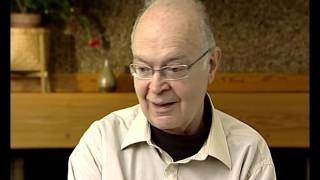
Donald Knuth (b. 1938), American computing pioneer, is known for his greatly influential multi-volume work, 'The Art of Computer Programming', his novel 'Surreal Numbers', his invention of TeX and METAFONT electronic publishing tools and his quirky sense of humour. [Listener: Dikran Karagueuzian; date recorded: 2006]

TRANSCRIPT: So not too surprisingly, I suddenly came down with a bleeding ulcer, and I was, you know, I was in the hospital. So I had all these other things going on, no time to do the research that was coming up, and then it turned out that my body rebelled. And the doctor showed me a book of his that described what you might call the Type A Personality, which described me to a T, and said, ‘You know what? Don, you just can't live this way, it's not sustainable’. He was a wonderful doctor, he let me read his own textbooks, didn't, you know, didn't just say, doctor knows best, listen to me. He let me understand my condition, and I got shots. He gave me shots to restore the iron that I'd lost from bleeding, some more, you know, medication, tell me to change my lifestyle, only do this much. So I resigned from all my editorial duties. You know, I wrote to my publisher with a black frame around the letter, saying, ‘I'm sorry, I know you wanted me to finish Volume Two this year, but I'm in the hospital; I can't finish it, you know, I'm doing my best, I’ll continue working’. The day that this ulcer occurred, I can tell you exactly where I was in Volume Two, because if you look in the index to Volume Two, there's an index entry called Brute Force, and I was trying to solve an exercise by Brute Force, at the time, and I just put that there as a reminder, so I can know exactly where I was at the time when this low point occurred.

But then when I realized that I was doing too much, and I started… and I could still, you know, change my lifestyle and learn about the concept of mañana, and so on, doctor allowed me to go to Copenhagen and give my lectures there. These were lectures about yet another idea, about syntax of… and semantics of programming languages, and it was to an international summer school being held in Copenhagen. I hadn't prepared the lectures in advance, I… sort of knew what I wanted to talk about. And so I had a week, I got there a week early, so that I could prepare my lectures to be given the next week. And in Copenhagen they have these wonderful forests, so I went and sat under a tree, and started planning my lecture. Well, then it turned out that the other lecturer for the first week, Niklaus Wirth, had called up, and he had been on a round-the-world trip, and he had caught dysentery in India, and wasn't able to lecture.  So they moved up my lectures to the first week, from the second week, so I had to prepare… you know, so I had only… I can only be, sort of, a day ahead of my lecture. On Monday I could prepare Tuesday's lecture, and so on, and go back to the forest and figure out what I'm going to say on Wednesday. And those lectures were presenting original material that I, you know, hadn't been done before. And I was recovering from ulcers, but I was taking it easy, I was trying to, you know, do this all relaxing and so on, and I actually enjoyed being in the forest under the trees, because it was a nice way to do research. And that all worked out, the students were helpful, and helped me solve some of the problems that came up in that day, and so that worked out. Then I went to Oxford, for a conference, where I presented my theorem about theorems about the Knuth-Bendix Algorithm, and I was able to write that paper on the plane, for… or during the second week of when I was in Copenhagen, and on a trip to France, I had a couple of days to think about attribute grammars.

So this was 1967, and it was the most creative time in my life, in the sense that three ideas that I had that turned out to be important in the field of computer science, the… certainly the attribute grammars and the Knuth-Bendix Algorithm, plus the third idea about top-down syntax analysis, which is less important, but still not bad, all came out that year.  And I had to do them all by stealing a few minutes of time here and there, from the problems that I was really supposed to be working on, which is my family, my book, my teaching. And so I've always wondered whether or not this is, you know, would I have been so creative if I hadn't been under such strain? If I'm designing a Research Institute, would the ideal design be something where you have babies screaming, and people are sleep-deprived, and you know, and bombarded with responsibilities, and then they would produce better research? Or where they, you know, have a luxurious setup with comfortable surroundings and so on? [...]

Read the full transcript at https://www.webofstories.com/play/donald.knuth/36
More from this channel
-
 2:45
Jules Engel - So who is responsible for a great animation?
2:45
Jules Engel - So who is responsible for a great animation?
-
 2:30
Donald Knuth - Honorary doctorates (86/97)
2:30
Donald Knuth - Honorary doctorates (86/97)
-
 5:14
Donald Knuth - Writing a book about the Bible: "3:16" (72/97)
5:14
Donald Knuth - Writing a book about the Bible: "3:16" (72/97)
-
 4:19
Donald Knuth - Re-writing TeX using the feedback I received (67/97)
4:19
Donald Knuth - Re-writing TeX using the feedback I received (67/97)
-
 2:16
Donald Knuth - Deciding to make my own typesetting program (51/97)
2:16
Donald Knuth - Deciding to make my own typesetting program (51/97)
-
 1:30
Murray Gell-Mann - The summer of 1963 (110/200)
1:30
Murray Gell-Mann - The summer of 1963 (110/200)
-
 1:32
Murray Gell-Mann - Quarks, mass shell analysis and the bootstrap (102/200)
1:32
Murray Gell-Mann - Quarks, mass shell analysis and the bootstrap (102/200)
-
 2:52
Freeman Dyson - Work with the Disarmament Agency (129/157)
2:52
Freeman Dyson - Work with the Disarmament Agency (129/157)