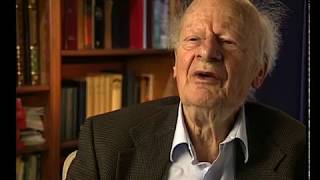
Jean-Claude Carrière - Meeting Buñuel (24/80)
745 views · Published 14 August 2017 · 3:13 · Indexed 20 September 2026
Channel: Web of Stories - Life Stories of Remarkable People · 2017 · Film & Animation
To listen to more of Jean-Claude Carrière’s stories, go the playlist: https://www.youtube.com/watch?v=gZ8mdzVJP5Q&list=PLVV0r6CmEsFzAPXfOhrKc9IPWO97IUQp4

French screenwriter Jean-Claude Carrière (1931-2021) worked with many film-makers, most notably Luis Buñuel. He wrote screenplays for films including 'Belle de Jour', 'The Discreet Charms of the Bourgeoisie', 'Tin Drum' and 'Cyrano de Bergerac'. [Listener: Andrzej Wolski; date recorded: 2010]

TRANSCRIPT: I met Luis Buñuel shortly after Le Soupirant in 1963. The film was quite successful. And Micheline Rozan, who is still alive, was the manager of the Bouffes du Nord, she was taking care of me, guiding me. She found out that Buñuel wanted to make a film in France, The Diary of a Chambermaid adapted from the book by Octave Mirbeau, starring Jeanne Moreau. Micheline Rozan was her agent, and she knew he was looking for a screenwriter. He was looking for a French screenwriter, able to write in French and who would know the real France. That was what he requested. So Micheline Rozan sent me to see producer Serge Silberman, who sent me to Cannes to meet Buñuel for lunch. That was during the Cannes Film Festival, May '63. I arrived, still glowing with the success of Le Soupirant, and had also made another film, a documentary about the sex life of animals called Bestiaire d'Amour. I had written the text using a book by a great French biologist called Jean Rostand, son of Edmund Rostand who wrote 'Cyrano de Bergerac', which I would adapt much later. So it is a small world. So here I go, to meet up with Buñuel, with those films in Cannes, and the first question he asks has got nothing to do with films. We meet up, at an appointed time, in a restaurant, we are by ourselves, in a hotel just outside of Cannes, and he observes me with those eyes that could see everything. And he asks me this fundamental question which I was well aware wasn't an everyday or a superficial question. He asks, 'Do you drink wine?' So I told him, 'Yes, I not only drink it but I come from a family of wine makers', which was true. So his face lit up and he ordered two bottles and that broke the ice, it established something between us. Later he told me that if I'd had no talent we could at least have spoken about wine. So we started talking about lots of things, and it just so happened that the documentary about the animals was of special interest to him, because Buñuel had studied entomology. That was what he had chosen after school, when he went to university. He was interested in entomology. He was passionate about it his entire life. He was able to cite the names of every insect in Latin, he was extremely good at it, so he found interesting the fact that I had made that film, and then he also was interested in the fact that the film, and the shorts as well, were in the slapstick genre. We must not forget that the first Revolution Surrealiste, which was the great surreal magazine so we can assume that all the documents were very carefully selected, bore a picture of Buster Keaton.
More from this channel
-
 1:32
Murray Gell-Mann - Quarks, mass shell analysis and the bootstrap (102/200)
1:32
Murray Gell-Mann - Quarks, mass shell analysis and the bootstrap (102/200)
-
 1:22
John Maynard Smith - Speculations on the origins of life and Haldane's 3 theorems (102/102)
1:22
John Maynard Smith - Speculations on the origins of life and Haldane's 3 theorems (102/102)
-
 2:00
John Maynard Smith - Experiencing feminism in science (83/102)
2:00
John Maynard Smith - Experiencing feminism in science (83/102)
-
 1:34
Brian Aldiss - Charles Monteith – a kindred spirit (17/79)
1:34
Brian Aldiss - Charles Monteith – a kindred spirit (17/79)
-
 4:00
Hans Bethe - The importance of support for pure science (97/158)
4:00
Hans Bethe - The importance of support for pure science (97/158)
-
 4:06
Hans Bethe - Outbreak of World War II; scientists' efforts (82/158)
4:06
Hans Bethe - Outbreak of World War II; scientists' efforts (82/158)
-
 2:03
Hans Bethe - Short range order vs long range order in the metal alloy (46/158)
2:03
Hans Bethe - Short range order vs long range order in the metal alloy (46/158)
-
 4:15
James Black - Realising a new drug is needed for heart failure (28/33)
4:15
James Black - Realising a new drug is needed for heart failure (28/33)