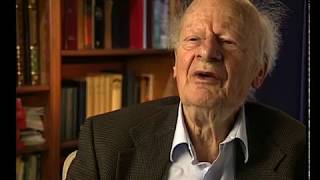
François Jacob - The Pasteur Institute (70/77)
178 views · Published 10 August 2017 · 4:08 · Indexed 20 September 2026
Channel: Web of Stories - Life Stories of Remarkable People · 2017 · Science & Technology
To listen to more of François Jacob, go to the playlist: https://www.youtube.com/watch?v=bBSb6rIJ0Sg&list=PLVV0r6CmEsFxcUFA9rIQwdpd7L7ayJnKk

François Jacob (1920-2013) was a French biochemist whose work focused on understanding how genes are controlled. In 1965, he shared the Nobel Prize in Physiology or Medicine with Jacque Monod and André Lwoff for his contribution to the field of biochemistry. [Listener: Michel Morange; date recorded: 2004]

TRANSCRIPT: [MM] We haven't really talked about the Pasteur Institute where your scientific career was made. Completely. So firstly there's the discovery of the Pasteur Institute that you write about in 'The Statue Within', a placed filled with traditions and history...

All you need to see is the crypt. It's extraordinary, have you been to see it? Yes. You have to admit that it's astonishing. It's surprising, yes.

[MM] A blend of scientism and religiosity. Absolutely.

Absolutely. Amazing. And what is surprising, I don't know if it still takes place and if you've done it, but it's the annual visit on the anniversary of what I think is Pasteur's death, where the whole of the institutes parades in front of the tomb, one by one. That is also incredible, particularly in such a place.

[MM] But really, those were traditions which were both rich, but at the same time could be a little unproductive sometimes.

Yes, of course. But at the start there were incredible guys.

[MM] For example?

There was a guy that came... when I got there, one of my first discoveries at the Pasteur Institute, was to find a guy who got there at noon, cooked his steak on the Bunsen burner and left at quarter past one. That was his day at the Pasteur Institute.

[MM] And it was perfectly tolerated.

No problem. Nobody paid attention to it. That's what was good. It was the good side, the aspect of total liberty. Absolutely. The good side of the place. It's changed a lot. It was something, it was so calm, you could do whatever you wanted. And also do nothing, we could do as we wanted at the time in the Pasteur Institute.

[MM] There weren't any laboratory controls, hearing, nothing like that?

Right at the beginning, when I arrived, right at the beginning, no. It really changed afterwards. But at the beginning, there was hardly any control. So there was... and the whole institute was suspicious of the Lwoff-Monod group. They were completely separated, taking refuge in a... the proof that they were suspicious of Lwoff, is that he was given the attic up there. And that he was confined in his attic. That was also quite surprising. And a lot was needed for him to... it took a Nobel Prize for it to change. It's quite astonishing. And that was in the sixties. In the fifties and sixties.

[MM] And who was behind the change?

Well, there were three guys who brought about the revolution. There was Wollman, there was Virat, which probably doesn't mean anything to you, he was a veterinary surgeon, and there was a third one, Panthier, Jean-Jacques' father. Those were the three guys who plotted and brought about the revolution at Pasteur. Meaning that they... there was... It was boiling, there was, the director was Tréfouël, who was very nice, but who was still really extraordinary. Tréfouël was a member of the Academy, there weren't many, nobody from here, of the group, neither Lwoff nor Monod had anything to do with the Academy. But since we wanted our notes at the Academy, we needed an academician to present the note. So, we would go to see Tréfouël. We would bring a note on bacteriophage to Tréfouël. He would say, 'It's absolutely fantastic, it's exactly like the chemistry of I don't know what'...

[MM] You couldn't really see the link.

No. We would say, 'Yes, yes, you're right'. And he would take our note and bring it to the Academy.
More from this channel
-
 1:32
Murray Gell-Mann - Quarks, mass shell analysis and the bootstrap (102/200)
1:32
Murray Gell-Mann - Quarks, mass shell analysis and the bootstrap (102/200)
-
 1:22
John Maynard Smith - Speculations on the origins of life and Haldane's 3 theorems (102/102)
1:22
John Maynard Smith - Speculations on the origins of life and Haldane's 3 theorems (102/102)
-
 2:00
John Maynard Smith - Experiencing feminism in science (83/102)
2:00
John Maynard Smith - Experiencing feminism in science (83/102)
-
 1:34
Brian Aldiss - Charles Monteith – a kindred spirit (17/79)
1:34
Brian Aldiss - Charles Monteith – a kindred spirit (17/79)
-
 4:00
Hans Bethe - The importance of support for pure science (97/158)
4:00
Hans Bethe - The importance of support for pure science (97/158)
-
 4:06
Hans Bethe - Outbreak of World War II; scientists' efforts (82/158)
4:06
Hans Bethe - Outbreak of World War II; scientists' efforts (82/158)
-
 2:03
Hans Bethe - Short range order vs long range order in the metal alloy (46/158)
2:03
Hans Bethe - Short range order vs long range order in the metal alloy (46/158)
-
 4:15
James Black - Realising a new drug is needed for heart failure (28/33)
4:15
James Black - Realising a new drug is needed for heart failure (28/33)