Funny Signs in China: What's the Real Meaning?
1,234 views · Published 30 July 2016 · 3:14 · Indexed 27 October 2026
Channel: eChineseLearning · 2016 · Education
Join us for a free trial today: http://goo.gl/5YyFgl

"Carefully Bang Head"? "Carefulness Bump Head?" "Look out, Knock Head?"

These funny mistranslations are just a few of the many ways 小心碰头 (xiǎoxīn pèng tóu) has been mistranslated in China.

“碰 (pèng)” means “bang” or “knock,” while “头 (tóu)” is the word for “head.” So, instead of misguidedly commanding you to hit your head carefully, this example should read: “be careful of banging your head,” or more formally, “mind your head.”

Then, there's the funny sign for 小心滑倒 (xiǎoxīn huá dǎo). What does this mean?


Express Yourself: How to Say “I’m mad!” in Chinese
VICTORIA WEIYA
No matter how calm, almost everyone ‘blows up’ every now and then. Before you do something crazy, let someone know how you feel!

In Chinese “我很生气 (wǒ hěn shēngqì) means “I am mad!”

I found this video really helpful for hearing a native speaker pronounce it, as well as other expressive phrases.

7 views · Written Jul 24
UpvoteDownvoteCommentShare
Adventurous Eating: Chinese Street Food!
VICTORIA WEIYA
Are you a “吃货(chīhuò) foodie?” In every Chinese city there are fast, affordable and delicious restaurants available on the street or at traditional markets. In English we call this: street food, hawker fare, stall food, or food vendors. You can sit on a small chair and hear the sounds of the city while enjoying a great value in dining. The owners don’t need to spend on decoration and A/C, so you can enjoy amazing meals at a cheap price. Sure, it’s not “Five-Star,” but you’ll leave happy!

In Chinese we call this “大排档 (dàpáidàng).” Of course, the food doesn’t come off the “street,” it is just eaten within view of the street (and often past midnight)!


You will find a huge variety of delicious food at the “大排档 (dàpáidàng).” These include various snacks, BBQ, noodle soups drinks and many more. Some foods unusual to a foreigner, such as the “臭豆腐 (chòudòufu) stinky tofu” can also be found.

You can recognize “大排档 (dàpáidàng).” from the simple décor, spices on the table, and disposable “筷子 (kuàizi) chopsticks” that are easy to grab from any seat. Take a seat and enjoy!

Examples:

Jīntiān wǎnshang, wǒmen qù chī dàpáidàng ba?
今天 晚上, 我们 去 吃 大排档 吧?
How about go out for the street food tonight?

Qítā fànguǎn dōu guānmén le, wǒmen qù chī dàpáidàng ba.
其他 饭馆 都 关门 了, 我们 去 吃 大排档 吧。
All the restaurants are closed now, so let’s grab some street food.

Búyào dānxīn nǐ de zhuózhuāng, wǒmen zhǐshì qù chī dàpáidàng.
不要 担心 你 的 着装 , 我们 只是 去 吃 大排档。
Don’t worry about your attire, it’s just a street food restaurant!

When and How to Use “大排档 (dàpáidàng)”

If your Chinese friends suggest an expensive restaurant and your pockets aren’t full, you may simply want some tasty street food! Feel free to express your love of “大排档 (dàpáidàng)” and comment on the nice weather outside. “大排档 (dàpáidàng)” doesn’t describe the type of dish you’d like, so continue the conversation from there.
519 views · 2 upvotes · Written Jul 23
Upvote2DownvoteCommentShare
Chinese Vocab: DRINKS
VICTORIA WEIYA
water = 水 (shuǐ)

coffee = 咖啡 (kā fēi)

milk = 牛奶 (niú nǎi)

tea = 茶 (chá)

green tea = 绿茶 (lǜ chá)

soda = 苏打水 (sū dá shuǐ)

soft drink = 软饮料 (ruǎn yǐn liào)

juice = 果汁 (ɡuǒ zhī)

orange juice = 橙汁 (chénɡ zhī)

lemonade = 柠檬汁 (nínɡ ménɡ zhī)

beer = 啤酒 (pí jiǔ)

champagne = 香槟酒 (xiānɡ bīn jiǔ)

cocktail = 鸡尾酒 (jī wěi jiǔ)

cognac = 干邑 (ɡān yì)

gin = 杜松子酒 (dù sōnɡ zǐ jiǔ)

liquor = 烈酒 (liè jiǔ)

vodka = 伏特加 (fú tè jiā)

whiskey = 威士忌 (wēi shì jì)

wine = 葡萄酒 (pú tɑo jiǔ)

white wine = 白葡萄酒 (bái pú tɑo jiǔ)

red wine = 红葡萄酒 (hónɡ pú tɑo jiǔ)

Listen to native speakers say each word
12 views · Written Jul 22
UpvoteDownvoteCommentShare
Travel China: You Want Me To What??
VICTORIA WEIYA
Did you know that in China warning signs will often be shown in both Chinese characters and translated English? Take this sign for instance:


If you saw this hanging by a doorway, would you know what it meant?

Turns out this is just one of the many ways 小心碰头 (xiǎoxīn pèng tóu) has been mistranslated. Others include “carefulness bump head,” “carefully hits to the forehead,” and the more threatening “look out, knock-head.”

“碰 (pèng)” means “bang” or “knock,” while “头 (tóu)” is the word for “head.”

And what about the sign for 小心滑倒 (xiǎoxīn huá dǎo)?

What sounds like a kid’s playground notice is actually a warning to be careful because the floor in this area is slippery.

小心 (xiǎoxīn) is a verb which means “to be careful (of something)” or “to look out.”

The confusion arises because 小心 (xiǎoxīn) is also commonly used as “carefully” or “carefulness”–as in drive carefully.

That’s why signs instructing you to “bang head carefully,” “carefully slip and fall down,” or “fall carefully into water” are common in China.

So, next time you're in China keep an eye out for one of these laughably translated signs!
More from this channel
-
 1:16
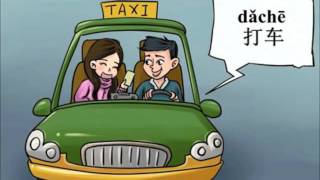
打车(dǎchē) Catch a cab
-
 0:48
Learn about Preserved Egg 皮蛋 (pídàn), one of China's Most Unusual Foods
-
 0:54
Do you love to spend money? Learn the idiom 大手大脚 (dà shǒu dà jiǎo)
-
 0:47
Instant noodles, or you need a toilet? Learn the meanings of 方便 (fāngbiàn)!
-
 4:57
Really? Seriously? "You Are Really Something!" in Chinese
-
 0:50
Ask to Use the Bathroom in Chinese. Don't be left out!
-
 2:44
Congratulate Your Friends in Chinese: learn "Good job!"
-
 0:53
Need some time? Learn "Wait a Moment" in Chinese!