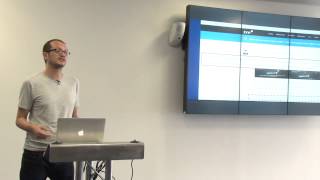
Thomas Kluyver, Min Ragan Kelley - Jupyter: Notebooks in Multiple Languages for Data Science
2,776 views · Published 26 March 2016 · 42:40 · Indexed 30 October 2026
Channel: PyData · 2016 · Science & Technology
PyData Amsterdam 2016

We'll talk about how the Jupyter Notebook has evolved from a Python specific tool to a general data science tool that supports many different languages, and about our own experiences in supporting a wide variety of languages for data science. We'll also demonstrate some of the new features and ideas being developed in and around the project.

Jupyter notebooks have become an invaluable tool for all kinds of data science. Originally developed as part of the IPython project, notebooks have evolved from a Python specific tool to support many programming languages; more than 50 different execution kernels have now been published. For all of these languages, notebooks are a way to record and describe a data science workflow, and then share it, publicly or privately, allowing the recipients to easily modify and execute the code.

We’ll describe the architectural changes and decisions involved in the transition to supporting multiple languages, as well as our own experience in supporting data science languages ranging from C++ to R to Bash. You’ll also get a high-level understanding of how to create a new kernel, if a language you’re excited about is not yet supported.

We’ll also highlight some of the current development work taking place in and around Jupyter, including redesigned UI, mechanisms for collaboration on notebooks, ways to share live, executable notebooks online, and projects that reuse the Jupyter machinery in different user interfaces.

Slides available here: https://docs.google.com/presentation/d/1PHnnkKYgjq1lcSDaVyhZP0Fs7qC70iA07b2Jv0uisUE/edit?usp=sharing 00:00 Welcome!
00:10 Help us add time stamps or captions to this video! See the description for details.

Want to help add timestamps to our YouTube videos to help with discoverability? Find out more here: https://github.com/numfocus/YouTubeVideoTimestamps
More from this channel
-
 31:23
Kostas Perifanos - Authorship Attribution Using Python
-
 31:08
Prash Majmudar - Measuring the Digital Economy Using Big Data
-
 36:26
Ian Ozsvald - The High Performance Python Landscape
-
 37:48
Mike Muller - Shared Memory Parallelism with Python
-
 35:01
Martin Goodson - Most Winning A/B Test Results are Illusory
-
 30:19
Mark Basham - Python for High Throughput Science
-
 1:13:42
David Cournapeau & Simon Jagoe - Narrowing the Gap Between Array Computing and Databases
-
 31:38
Emlyn Clay - Phython, Pharmaceuticals & Discovery