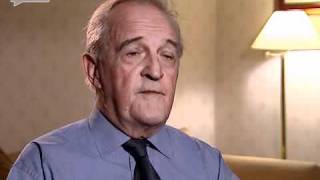
Aleksander Smolar - Falling out with Adam Michnik (172/201)
627 views · Published 20 December 2018 · 3:40 · Indexed 3 October 2026
Channel: Web of Stories - Life Stories of Remarkable People · 2018 · News & Politics
To listen to more of Aleksander Smolar’s stories, go to the playlist: https://www.youtube.com/playlist?list=PLVV0r6CmEsFwlxPLurqAOCrabBgGrqLA7

Aleksander Smolar (b. 1940) is a Polish writer, political activist and adviser, vice-president of the Institute for Human Sciences and president of the Stefan Batory Foundation. [Listener: Vitek Tracz]

TRANSCRIPT: Things were worse in '89 when [Michnik] came to Paris for the first time. I've already spoken about this, but I remember that visit because it was very painful. We were very close and had a very warm relationship. In some sense it still is even though we don't see one another for months at a time or even longer. But I think that emotionally it is mutual, that there is an attachment there. When he came here on a wave of euphoria just before the election following the Round Table talks, he appeared publicly with Father, now Bishop, Orszulik at the Pallottines. Later, we went for dinner with Basia Toruńczyk, who was also my close friend, and that's when I said to him – I'm not going to recreate the whole scene – 'Don't you think that it was a mistake that the social side, namely the Solidarność opposition, forced through an indexation or, in other words, the automatic increase in worker's wages along with the price increase?' It was a time of hyperinflation. From the point of view of the economy, this decision was clearly suicidal. This was quickly changed, the opposition withdrew from this arrangement once it came to power. However, Adam became very tense and said, 'Listen, Alik. Before you start asking these sorts of questions, say just how great a thing we've done historically' and so on and on. 'And then you can ask your questions'. Oh I knew that relations were changing. Never mind, I won't go into the details. There were quite a few painful scenes later in Poland once I went back, when we differed fundamentally in our judgement and opinions. And this was something that he didn't tolerate. We had some terrible rows which were pretty scandalous. I remember a few of those scenes although there haven't been any for a long time – we both avoid them even though we still have very different opinions. You could say that in some sense this is undoubtedly because of our views, our concepts but it's also down to our personalities. He's a fighter with polarised views and he was always at his best when there was a confrontation with an enemy. I, on the other hand, have a temperament which… you could say that Aron definitely influenced me here. I tend to see the ambivalence in a situation, I see both of its aspects, I see the world of divergent rationales although as I've already said, I always made a choice. This doesn't mean that I stood to one side. My position was always clear and was essentially the same as Adam's, but the path I followed to get there was different, namely I believed that one pays a price for this – the price of divisions – and it's not the case that the other side is totally wrong. I mean, I could see the faults and the sins on our part and this is still the case to this day. I'm preparing to write an article which might contain some explosive content in that respect.
More from this channel
-
 0:44
David Weatherall - Entering medical school
0:44
David Weatherall - Entering medical school
-
 2:22
Baruch Blumberg - The link between some cancers and viruses
2:22
Baruch Blumberg - The link between some cancers and viruses
-
 2:26
Marek Edelman - Different criteria for measuring the value of human life
2:26
Marek Edelman - Different criteria for measuring the value of human life
-
 2:45
Jules Engel - So who is responsible for a great animation?
2:45
Jules Engel - So who is responsible for a great animation?
-
 5:02
Eugene Garfield - Retractions in citations
5:02
Eugene Garfield - Retractions in citations
-
 4:42
Redmond O'Hanlon - When the men come back...
4:42
Redmond O'Hanlon - When the men come back...
-
 3:08
Russell Fernald - Advice for young scientists: 'The fear of doing anything unconventional'
3:08
Russell Fernald - Advice for young scientists: 'The fear of doing anything unconventional'
-
 2:30
Donald Knuth - Honorary doctorates (86/97)
2:30
Donald Knuth - Honorary doctorates (86/97)