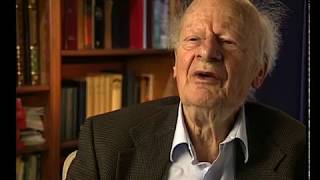
Walter Lassally - Making a film about squatters with Derek York (18/266)
81 views · Published 22 August 2017 · 3:39 · Indexed 20 September 2026
Channel: Web of Stories - Life Stories of Remarkable People · 2017 · Film & Animation
To listen to more of Walter Lassally’s stories, go to the playlist: https://www.youtube.com/playlist?list=PLVV0r6CmEsFyohoA7fblRacvxrYprvzfm

Born in Germany, cinematographer Walter Lassally (1926-2017) was best known for his Oscar-winning work on 'Zorba the Greek'. He was associated with the Free Cinema movement in the 1950s, and the British New Wave in the early 1960s. [Listener: Peter Bowen; date recorded: 2004]

TRANSCRIPT: Derek York is somebody whom I met when I went to the Holborn Film Society. Because at that time, in the '40s, '46, '47, that sort of period, I used to go to film societies to see the latest foreign movies, which you could only see in film societies, even before... there were a couple of specialist cinemas in London, but very few, and often you had to go to a film society if you wanted to see something out of the way, out of the ordinary. And at one of those film society screenings, at the Holborn Film Society, I met Derek York and we soon discovered that we had similar interests. We both wanted to become film-makers. He was a writer and became a director. So we got together, and I got him a job at Kinocrat. I was there first and he joined us. Then, we decided to make a rather more elaborate film. More elaborate, that is, than 'Watch the Birdie'. And at that time the squatter's movement happened in London where... it was communist inspired, but not entirely communist in nature. But there was a... there was a considerable housing shortage, but at the same time there was... there were many empty properties which, for some reason or other, couldn't be occupied, or couldn't be let. So the squatter's movement was... they broke into these empty properties and squatted in there to draw attention to the housing problem. When this movement was at its height and they were being pursued by the police and got out, and there was quite a few battles going on. So during that time, we took the opportunity, we quickly borrowed a camera from Kinocrat, I imagine, it must have been, and we filmed some of those events taking place in the West End of London, in a place called the Ivanhoe Hotel, that was one place that was occupied, and the other places were just office buildings or private flats, or things that just happened to be standing empty. And we managed to get some shots of people moving furniture in through the windows, because the doors were locked, underneath it was padlocked. The proper entrance was padlocked. They smuggled furniture in and... so we got three or four documentary pieces, like newsreel, bits. And they formed the centrepiece of this film, 'Smith Our Friend', where Derek wrote a framing story about a returning serviceman, somebody coming home from the war, being demobbed, they call it, demobilised, demobbed, carrying a little cardboard box, which had a suit in it which was given to you by the government. You see, when you were demobbed you had this cardboard box with a suit in it. And, so this film starts with this guy coming out with his cardboard box and being welcomed home by his wife and child at a very slummy place in East London somewhere, in Stepney, and then you see the house is badly in need of repair, the roof leaks, the walls are damp, and the whole place is very much in need of care and maintenance. And we actually staged this. We took some more actual shots in real... people's real houses who were living under very, very poor conditions, but the main part of the story was staged in a school hall, because Derek's father was a caretaker.
More from this channel
-
 1:32
Murray Gell-Mann - Quarks, mass shell analysis and the bootstrap (102/200)
1:32
Murray Gell-Mann - Quarks, mass shell analysis and the bootstrap (102/200)
-
 1:22
John Maynard Smith - Speculations on the origins of life and Haldane's 3 theorems (102/102)
1:22
John Maynard Smith - Speculations on the origins of life and Haldane's 3 theorems (102/102)
-
 2:00
John Maynard Smith - Experiencing feminism in science (83/102)
2:00
John Maynard Smith - Experiencing feminism in science (83/102)
-
 1:34
Brian Aldiss - Charles Monteith – a kindred spirit (17/79)
1:34
Brian Aldiss - Charles Monteith – a kindred spirit (17/79)
-
 4:00
Hans Bethe - The importance of support for pure science (97/158)
4:00
Hans Bethe - The importance of support for pure science (97/158)
-
 4:06
Hans Bethe - Outbreak of World War II; scientists' efforts (82/158)
4:06
Hans Bethe - Outbreak of World War II; scientists' efforts (82/158)
-
 2:03
Hans Bethe - Short range order vs long range order in the metal alloy (46/158)
2:03
Hans Bethe - Short range order vs long range order in the metal alloy (46/158)
-
 4:15
James Black - Realising a new drug is needed for heart failure (28/33)
4:15
James Black - Realising a new drug is needed for heart failure (28/33)