8303 Grafts. Hair Transplant by FUE Technique. DUPA. Injertocapilar.com. 1335/2013
2,797 views · Published 1 March 2017 · 3:49 · Indexed 16 November 2026
Channel: Injertocapilar España · 2017 · Science & Technology
Website: https://injertocapilar.com (Español);https://injertocapilar.com/?lang=en (English)
Questionnaire: https://injertocapilar.com/diagnostico-online/(SP) https://injertocapilar.com/online-diagnosis-2/?lang=en (EN)
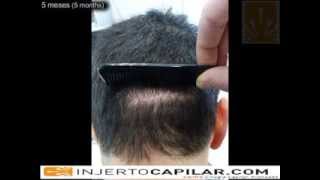
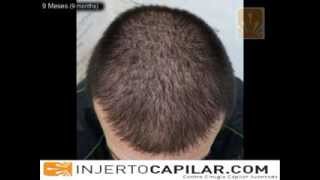
- Paciente de 45 años en tratamiento con finasteride hace 17 años. Patrón de alopecia tipo DUPA, con donante con poca capacidad de cobertura, pero unidades foliculares conservadas por el tratamiento médico (hidden DUPA). Como en todos los pacientes que hemos presentado, consideramos candidatos a cirugía a los pacientes con afectación androgénica de la zona donante siempre y cuando estén medicados y sean conscientes de la inestabilidad de la donante sin esa medicación. Se plantea una estrategia en 3 pasos para homogeneizar la zona receptora. Donante con pelo de 45 micras, 2,2 pelos por unidad folicular, valor de cobertura en torno a nueve, pero con una capacidad donante total de 10.000 unidades (área total donante 227 cm2). Se realiza una primera intervención con 3101 grafts para coronilla (7238 pelos; 2,33 pelos/graft; 0.7 mm punch; 413G1/ 1612G2/ 1091G3/ 113G4/ 1G5). A los 7 meses se realiza la segunda intervención para el frontal con otros 3101 grafts (6803 pelos; 2,19 pelos/graft; 0.7-0.8 mm punch;  441G1/ 1756G2/ 835G3/ 68G4/ 1G5). Un año después se realiza la tercera cirugía para aumentar densidad general con 2101 grafts (4913 pelos; 2,34 pelos/graft; 0.7-0.8 serrado mm punch; 162G1/ 1132G2/ 742G3/64G4/1G5). En este momento el valor de cobertura de la donante es 7,6 (T), 6,9 (P) y 6,2 (O), y su capacidad donante total  es de 4745 grafts. Se enseña video antes de la tercera operación. Se mostrarán resultados finales después de esta tercera cirugía.

This 45-year-old patient has been in treatment  with finasteride for 17 years. He has a DUPA pattern, but with a well preserved donor area due to the medical treatment (hidden DUPA). As in all the cases that we have been presenting about DUPA patients, we consider them candidates to surgery (knowing that they have an unsafe area) in the only case that they are with med's, and are aware of the instability of the donor without that medication. We planned a 3-step strategy to homogenize the recipient area. Donor characteristics with 45 microns hair caliber, 2.2 hairs per follicular unit, donor coverage value of nine on average, but with a total donor capacity of 10,000 grafts (total donor area of 227 cm2). We performed a first procedure with 3101 grafts for the crown (7238 hairs; 2.33 hairs/ graft; 0.7 mm punch; 413 G1 / 1612 G2 / 1091 G3 / 113 G4 / 1 G5). 7 months later we did his second procedure in the frontal area with another 3101 grafts (6803 hairs; 2.19 hairs/graft; 0.7-0.8 mm punch; 441G1 / 1756G2 / 835G3 / 68G4 / 1G5). A year later, we carry out the third surgery, to increase the overall density, with 2101 grafts (4913 hairs; 2.34 hairs / graft; 0.7-0.8 serrated mm punch; 162 G1 / 1132 G2 / 742 G3 / 64 G4 / 1 G5). At this time the coverage value of the donor is 7,6 (T), 6,9 (P) and 6,2 (O), and his total donor capacity, 4745 grafts. We show the video before his third procedure. Final results after this third surgery will be displayed. Dr. José Lorenzo. www.injertocapilar.com. Madrid. Spain.
More from this channel
-
 3:18
6558 FU's. Hair Transplant by FUE Technique. Advanced Alopecia. Injertocapilar.com. 314/2010
-
 3:16
1551 FU's. Hair Transplant by FUE Technique. Injertocapilar.com. 855/2012
-
 3:07
2353 FU's. Hair Transplant by FUE Technique. Injertocapilar.com. 824/2012
-
 1:24
Scar Repair. Hair Transplant by FUE Technique. Injertocapilar.com. 820/2012
-
 4:05
1802 FU's. Hair Transplant by FUE Technique. Shaved HT. Injertocapilar.com. 765/2012
-
 2:26
2801 FU's. Hair Transplant by FUE Technique. Injertocapilar.com. 739/2012
-
 2:58
2301 FU's. Hair Transplant by FUE Technique. Scar Repair. Injertocapilar.com. 736/2012
-
 2:39
1752 FU's. Hair Transplant by FUE Technique. Shaved HT. Injertocapilar.com. 688/2012