If `p,x_1,x_2,x_3....` and `q,y_1,y_2,y_3,...` from two infinite AP's with common difference `
403 views · Published 13 October 2018 · 4:57 · Indexed 27 September 2026
Channel: Doubtnut · 2018 · Education
To ask Unlimited Maths doubts download Doubtnut from - https://goo.gl/9WZjCW If `p,x_1,x_2,x_3....` and `q,y_1,y_2,y_3,...` from two infinite AP's with common difference `a` and `b` respectively. Then locus of `p(alpha,beta)` where `alpha=(1/n)[x_1+x_2+x_3+...+x_n]` and `beta=(1/n)[y_1+y_2+y_3+...y_n]` is
More from this channel
-
 2:28
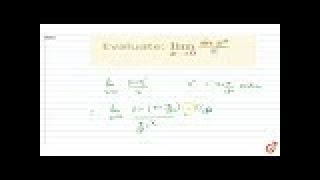
IIT JEE LIMITS AND DERIVATIVES Evaluate:
`("lim")_(xrarr0)(sinx^0)/x`
2:28
IIT JEE LIMITS AND DERIVATIVES Evaluate:
`("lim")_(xrarr0)(sinx^0)/x`
-
 4:29
IIT JEE LIMITS AND DERIVATIVES Evaluate the limit:
`("lim")_(xvecoo)((x+2)/(x+1))^(x+3)`
4:29
IIT JEE LIMITS AND DERIVATIVES Evaluate the limit:
`("lim")_(xvecoo)((x+2)/(x+1))^(x+3)`
-
 3:50
`A D` and `B E` are respectively altitudes of an isosceles triangle `A B C` with `A C=B C` . Pro...
3:50
`A D` and `B E` are respectively altitudes of an isosceles triangle `A B C` with `A C=B C` . Pro...
-
 4:19
IIT JEE PERMUTATIONS AND COMBINATIONS Find the number of distinct rational numbers `x`
such that ...
4:19
IIT JEE PERMUTATIONS AND COMBINATIONS Find the number of distinct rational numbers `x`
such that ...
-
 2:15
IIT JEE PERMUTATIONS AND COMBINATIONS Find the sum of the series `sum_(r=1)^n rxxr !dot`
2:15
IIT JEE PERMUTATIONS AND COMBINATIONS Find the sum of the series `sum_(r=1)^n rxxr !dot`
-
 2:47
JEE MAINS 2018 Find the points of local maxima and local minima,
if any, of each of the follo...
2:47
JEE MAINS 2018 Find the points of local maxima and local minima,
if any, of each of the follo...
-
 3:03
Find the number of polynomials of the form `x^3+a x^2+b x+c`
that are divisible by `x^2+1,w h e...
3:03
Find the number of polynomials of the form `x^3+a x^2+b x+c`
that are divisible by `x^2+1,w h e...
-
 2:58
IIT JEE PERMUTATIONS AND COMBINATIONS Prove that `"^n C_r+^(n-1)C_r+...+^r C_r=^(n+1)C_(r+1)`
.
2:58
IIT JEE PERMUTATIONS AND COMBINATIONS Prove that `"^n C_r+^(n-1)C_r+...+^r C_r=^(n+1)C_(r+1)`
.