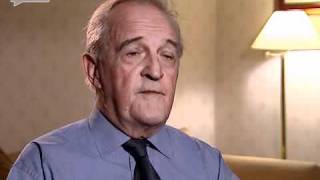
Aleksander Smolar - My friendship with Jacek Kuroń (173/201)
216 views · Published 20 December 2018 · 5:48 · Indexed 3 October 2026
Channel: Web of Stories - Life Stories of Remarkable People · 2018 · News & Politics
To listen to more of Aleksander Smolar’s stories, go to the playlist: https://www.youtube.com/playlist?list=PLVV0r6CmEsFwlxPLurqAOCrabBgGrqLA7

Aleksander Smolar (b. 1940) is a Polish writer, political activist and adviser, vice-president of the Institute for Human Sciences and president of the Stefan Batory Foundation. [Listener: Vitek Tracz]

TRANSCRIPT: There were other very important people although I wasn’t nearly as close to them. There was Jacek Kuroń, Karol Modzelewski. I met them later when I was a student when, as I’ve already mentioned, I was setting up the political club with Karol and which Jacek was always involved in. I had the constant impression that they were communicating between themselves and not including me. There was a certain lack of trust on my part. There were pretty fundamental issues concerning the way this institution functioned about which I knew nothing. I mean, I wasn’t even told about these things. The closeness between [Jacek and Karol] was evident and I knew about it. In any case, I found them extremely… I mean intellectually, I had more in common with Karol – Karol Modzelewski for whom I had a huge admiration. At that point, I wasn’t yet able to appreciate Jacek, his image which I found difficult, this image of an activist, a speaker at rallies whose expressions were too radical for my needs of subtle analysis, too simple and too radical. Later, I came to appreciate him much more and we became great friends. We were also in prison together. After that, there was no more contact. I left Poland and then following my return, Jacek and I would talk on the telephone when he became a government minister and then a candidate in the presidential elections. I watched as his health declined and as he simultaneously became increasing isolated politically. His views, too, became more radical. He reverted to his leftist roots and condemned his own life story, namely the things he did as minister, and the changes he implemented in ’89 he now refuted along with the formula that became famous and which he quoted in the '90s: if I were living in a normal developed democratic country, I would be a social democrat or a socialist – I can’t remember how exactly he said it. But we need to first build up capitalism and so that was a role he took on himself. He was fully aware of this.

Mazowiecki invited him to be the minister for social services, I don’t remember exactly… work and social services, I can’t remember the exact title. In any case, he said I was to have social care… I was to be minister of employment. He would wryly say that I became the minister of unemployment and of social poverty, and that he ought never under any circumstances to have renounced his left-wing convictions nor those with whom as a leftist he identified. This undoubtedly referred to working people, those who were bearing the cost, the significant cost of the transformation. But his rebuttal of his own history was, in my opinion, unjustified and he was harming himself because he had played a very significant role. Of course, we can’t discount the possibility that if a different developmental model had been implemented we might not now be faced with the present nationalist-populist reaction. However, I think that kind of reaction was unavoidable because we can see it in developed Western countries, too: Trump’s election, Brexit in Great Britain, Marion Le Pen who, although she didn’t win, had enormous support so it’s the extreme right which has its roots in pétinisme. In every single Western country – you could almost count them off one by one – this type of ideology, this movement is appearing. Of course, they didn’t rule in all of these places, they didn’t govern. This has only happened in Poland and in Hungary but I can’t discount that the Czech Republic at the time I’m speaking is going in that direction, too; there are some elements in other countries in our camp. Never mind. In any case, counterfactual history – this kind of hypothetical history can only ever be an intellectual experiment. We never know what history would have been like if certain facts had been different and if the lead actors had followed a different path. I believe that Jacek played a huge role.
More from this channel
-
 0:44
David Weatherall - Entering medical school
0:44
David Weatherall - Entering medical school
-
 2:22
Baruch Blumberg - The link between some cancers and viruses
2:22
Baruch Blumberg - The link between some cancers and viruses
-
 2:26
Marek Edelman - Different criteria for measuring the value of human life
2:26
Marek Edelman - Different criteria for measuring the value of human life
-
 2:45
Jules Engel - So who is responsible for a great animation?
2:45
Jules Engel - So who is responsible for a great animation?
-
 5:02
Eugene Garfield - Retractions in citations
5:02
Eugene Garfield - Retractions in citations
-
 4:42
Redmond O'Hanlon - When the men come back...
4:42
Redmond O'Hanlon - When the men come back...
-
 3:08
Russell Fernald - Advice for young scientists: 'The fear of doing anything unconventional'
3:08
Russell Fernald - Advice for young scientists: 'The fear of doing anything unconventional'
-
 2:30
Donald Knuth - Honorary doctorates (86/97)
2:30
Donald Knuth - Honorary doctorates (86/97)