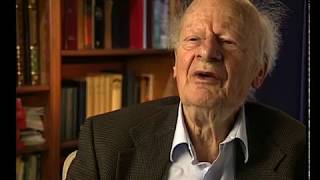
Murray Gell-Mann - Quarks, mass shell analysis and the bootstrap (102/200)
3,442 views · Published 17 May 2016 · 1:32 · Indexed 20 September 2026
Channel: Web of Stories - Life Stories of Remarkable People · 2016 · Science & Technology
To listen to more of Murray Gell-Mann’s stories, go to the playlist: https://www.youtube.com/playlist?list=PLVV0r6CmEsFxKFx-0lsQDs6oLP3SZ9BlA

New York-born physicist Murray Gell-Mann (1929-2019) was a theoretical physicist. His considerable contributions to physics include the theory of quantum chromodynamics. He was awarded the 1969 Nobel Prize in Physics for his work on the theory of elementary particles. [Listener: Geoffrey West; date recorded: 1997]

TRANSCRIPT: In the theoretical physics… fundamental theoretical physics community I think they were, once quarks were suggested, I think there were people who liked quarks and people who liked the mass shell analysis and the bootstrap and so on, but there were very few who felt comfortable with both. But I felt perfectly happy with the mass shell formulation, which I had helped to develop, and I was of course very happy with the quark formulation as well. And I didn't see any contradiction between them and I still don't. The part… the bootstrap of course is a somewhat ill-defined set of ideas, except that it… it's some sort… it… it utilises the consistency properties of mass shell amplitudes and some kind of condition to specify the theory, some sort of non-singularity condition to specify the theory. But the part I liked best about it was the idea of hadronic egalitarianism—'nuclear democracy' Geoff called it–but as soon as I started dealing with the quarks on that very same day, I decided the principle must be that all the observable hadrons are equally elementary or non-elementary. And I think that holds up to today also.
More from this channel
-
 1:22
John Maynard Smith - Speculations on the origins of life and Haldane's 3 theorems (102/102)
1:22
John Maynard Smith - Speculations on the origins of life and Haldane's 3 theorems (102/102)
-
 2:00
John Maynard Smith - Experiencing feminism in science (83/102)
2:00
John Maynard Smith - Experiencing feminism in science (83/102)
-
 1:34
Brian Aldiss - Charles Monteith – a kindred spirit (17/79)
1:34
Brian Aldiss - Charles Monteith – a kindred spirit (17/79)
-
 4:00
Hans Bethe - The importance of support for pure science (97/158)
4:00
Hans Bethe - The importance of support for pure science (97/158)
-
 4:06
Hans Bethe - Outbreak of World War II; scientists' efforts (82/158)
4:06
Hans Bethe - Outbreak of World War II; scientists' efforts (82/158)
-
 2:03
Hans Bethe - Short range order vs long range order in the metal alloy (46/158)
2:03
Hans Bethe - Short range order vs long range order in the metal alloy (46/158)
-
 4:15
James Black - Realising a new drug is needed for heart failure (28/33)
4:15
James Black - Realising a new drug is needed for heart failure (28/33)
-
 3:00
Baruch Blumberg - Getting married and continuing with clinical research (14/80)
3:00
Baruch Blumberg - Getting married and continuing with clinical research (14/80)