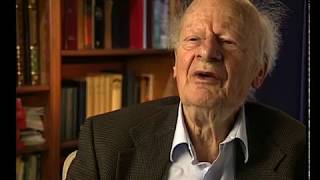
Sherwin Nuland - My method of writing (37/67)
146 views · Published 14 September 2017 · 4:04 · Indexed 20 September 2026
Channel: Web of Stories - Life Stories of Remarkable People · 2017 · Science & Technology
To listen to more of Sherwin Nuland’s stories, go to the playlist: https://www.youtube.com/watch?v=gnoweXrGs70&list=PLVV0r6CmEsFwS1mg7ZIN3gt8yKmoZ_o_F

US surgeon Sherwin Nuland (1930-2014) taught bioethics, the history of medicine, and medicine at Yale University. He was the author of ‘How We Die’, which made ‘The New York Times’ bestseller list and won the National Book Award. [Listener: Christopher Sykes]

TRANSCRIPT: I have to describe what it's like to write, because I don't have a method, but I have a method, which is to have no method. I've never made an outline, I've never planned an essay or a chapter. Essentially, what happens is that a beginning sentence comes to me, and I like its rhythm and I like the way it feels, and I like the way it sounds when I say it out loud, and I sit down and I start to write with a pencil and a tablet of paper. I write on every other line, and I just keep writing. And when the chapter is over, I reread it, and I might cross out words because, of course, I've left every other line blank, I can put a word in here, a sentence in there. I will usually then rewrite it, change little things that I need to, not a lot, just a little. And that is the copy from which I type it into the computer. And I'm still making revisions, but only revisions in individual words, only deciding that I need a comma here or a semicolon there, or dashes instead of brackets, that kind of thing. But essentially, that first writing, with the pencil on the paper, that gets fixed up a little bit as I go along the way, is essentially it.

I remember being interviewed after 'Lost in America', my memoir, came out, by Alex Witchel for 'The Times'. She's Frank Rich's wife and she's… actually a terrific writer of her own. She came up here to interview me, and she was having a little trouble believing that I just wrote this stuff, so at that time, I had sort of a little office box made of plastic, in which I had all the tablets in which I'd written the book, and I got up and I just pulled one out, and I said, you know, if you want to look at page 52 to 79 and compare it with this, you're going to find out it's almost exactly the same thing, because my books are very lightly edited. Nothing I've ever written has been very much edited.

So, I sit down and I write, but according to what scheme? Again, according to no scheme. I just let my subconscious go and when I read through the final manuscript of 'How We Die', again written with no plan except that one chapter would be on stroke and one chapter would be on Alzheimer's and one chapter would be on AIDS, when I read through that thing, even though I had read individual chapters as I went, I realized right away that the book had a beginning, it had a middle, it had a perfectly logical endpoint and the thing read as if I'd planned it out carefully, and I hadn't done a thing to plan it.
More from this channel
-
 1:32
Murray Gell-Mann - Quarks, mass shell analysis and the bootstrap (102/200)
1:32
Murray Gell-Mann - Quarks, mass shell analysis and the bootstrap (102/200)
-
 1:22
John Maynard Smith - Speculations on the origins of life and Haldane's 3 theorems (102/102)
1:22
John Maynard Smith - Speculations on the origins of life and Haldane's 3 theorems (102/102)
-
 2:00
John Maynard Smith - Experiencing feminism in science (83/102)
2:00
John Maynard Smith - Experiencing feminism in science (83/102)
-
 1:34
Brian Aldiss - Charles Monteith – a kindred spirit (17/79)
1:34
Brian Aldiss - Charles Monteith – a kindred spirit (17/79)
-
 4:00
Hans Bethe - The importance of support for pure science (97/158)
4:00
Hans Bethe - The importance of support for pure science (97/158)
-
 4:06
Hans Bethe - Outbreak of World War II; scientists' efforts (82/158)
4:06
Hans Bethe - Outbreak of World War II; scientists' efforts (82/158)
-
 2:03
Hans Bethe - Short range order vs long range order in the metal alloy (46/158)
2:03
Hans Bethe - Short range order vs long range order in the metal alloy (46/158)
-
 4:15
James Black - Realising a new drug is needed for heart failure (28/33)
4:15
James Black - Realising a new drug is needed for heart failure (28/33)