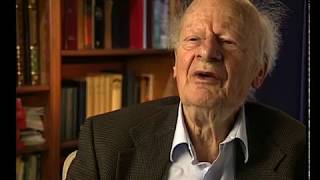
Aleksander Smolar - My prison cell mates (128/201)
104 views · Published 20 December 2018 · 2:01 · Indexed 20 September 2026
Channel: Web of Stories - Life Stories of Remarkable People · 2018 · News & Politics
To listen to more of Aleksander Smolar’s stories, go to the playlist: https://www.youtube.com/playlist?list=PLVV0r6CmEsFwlxPLurqAOCrabBgGrqLA7

Aleksander Smolar (b. 1940) is a Polish writer, political activist and adviser, vice-president of the Institute for Human Sciences and president of the Stefan Batory Foundation. [Listener: Vitek Tracz]

TRANSCRIPT: In any case, the conditions during the time I was in solitary confinement were difficult, but life in the cells could sometimes be wonderful. One outstanding memory was… it was an excellent cell – it was, it must have been around May 1st – probably both before and after – because we organised a revue to celebrate May Day in our cell. There were four of us. I became great friends with one of the people who was in that cell while we were in prison, and that was Janusz Szpotański who had been arrested for writing about 'gagglers'. These were people he regarded as the liberal intelligentsia that 'gaggled' but wasn't really harming the authorities. He was an amazingly good observer. The president there was a personage acclaimed by the opposition, Jan Józef Lipski who came from… not a communist background at all but from the real liberal opposition. There was another person there, a monster – Polan Haraszim who was a professor at the Jagiellonian University, he was originally from somewhere in Hungary. During the war he had collaborated with the Germans and then later with the Polish communist secret police. He was locked up because as he claimed – I'm assuming this was true – he'd taken bribes. He was head of the extramural courses in the Department of Law at the Jagiellonian University and he handed out diplomas, sold diplomas to, among others, various secret police agents, people in authority because those were the people who studied in these extramural departments to further their careers – this wasn't the first generation – and workers weren't accepted so some kind of education was required. So he and those diplomas… but was that true?
More from this channel
-
 1:32
Murray Gell-Mann - Quarks, mass shell analysis and the bootstrap (102/200)
1:32
Murray Gell-Mann - Quarks, mass shell analysis and the bootstrap (102/200)
-
 1:22
John Maynard Smith - Speculations on the origins of life and Haldane's 3 theorems (102/102)
1:22
John Maynard Smith - Speculations on the origins of life and Haldane's 3 theorems (102/102)
-
 2:00
John Maynard Smith - Experiencing feminism in science (83/102)
2:00
John Maynard Smith - Experiencing feminism in science (83/102)
-
 1:34
Brian Aldiss - Charles Monteith – a kindred spirit (17/79)
1:34
Brian Aldiss - Charles Monteith – a kindred spirit (17/79)
-
 4:00
Hans Bethe - The importance of support for pure science (97/158)
4:00
Hans Bethe - The importance of support for pure science (97/158)
-
 4:06
Hans Bethe - Outbreak of World War II; scientists' efforts (82/158)
4:06
Hans Bethe - Outbreak of World War II; scientists' efforts (82/158)
-
 2:03
Hans Bethe - Short range order vs long range order in the metal alloy (46/158)
2:03
Hans Bethe - Short range order vs long range order in the metal alloy (46/158)
-
 4:15
James Black - Realising a new drug is needed for heart failure (28/33)
4:15
James Black - Realising a new drug is needed for heart failure (28/33)