2. Ahern's BB 350 at Oregon State University - Water & Buffers
4,324 views · Published 5 April 2017 · 52:32 · Indexed 29 October 2026
Channel: Kevin Ahern's YouTube Videos - Lectures and More · 2017 · Education
1. Contact - [email protected]
2. Kevin's lectures with The Great Courses - https://www.thegreatcoursesplus.com/biochemistry-and-molecular-biology-how-life-works?tn=Expert_tray_Course_1_0_12943
3.  Kevin's Lecturio videos for medical students - https://www.lecturio.com/medical-courses/biochemistry.course
4. Course materials at https://kevingahern.com/biochemistry-resources/
5. Course video channel at https://www.youtube.com/watch?v=JSntf0iKMfM&list=PLlnFrNM93wqz37TUabcXFSNX2nJtrJnkx
6.  Metabolic Melodies at https://teeheetime.com/category/lyrics-science/
7.  Kevin's Free Biochemistry books - https://kevingahern.com/biochemistry-resources/
8.  Kevin's Pre-med Audio course on Listenable - https://listenable.io/web/courses/143/kevin-aherns-guide-to-getting-into-medical-school/

Highlights Water/Acids

1. Water is a bent molecule. Electrons are not shared equally by oxygen and the hydrogens, resulting in the hydrogens having a partial positive charge and the oxygen having a partial negative charge. These partial charges give rise to hydrogen bonds. Note that the attraction of a nucleus for electrons is measured by electronegativity. The higher the electronegativity, the stronger the attraction for electrons.

2. Ionic (polar) compounds will be pulled apart in water. We say that they dissolve. In this case, the ions (charged molecules, such as K+) are surrounded by the correspondingly opposite partial charge of the water molecule. Thus, K+ is most closely associated with the oxygen component of the water molecule since the oxygen is the most negatively charged. This is an example of an ion-dipole interaction and is very common in water.

3. Bond energies are measures of the amount of energy it takes to break a bond. Covalent bonds (such as those between oxygen and hydrogen in water) are extraordinarily strong compared to hydrogen bonds (by a factor of about 20). Nonetheless, hydrogen bonds contribute significantly to the properties of water and biological molecules.

4. We use the term hydrophilic to refer to compounds that are soluble in water and hydrophobic to refer to compounds that are not soluble in water. The term 'amphiphilic' or amphipathic is used to refer to compounds that have parts of them that 'like' water and parts of them that repel water. Fatty acids (in soaps) are a perfect example of an amphiphilic compound. We shall see later that the lipids in membranes are amphiphilic.

5. Many biological compounds are hydrophilic. Examples include sugars, amino acids, nucleic acids, and most proteins. Fat is the predominant hydrophobic compound found in cells. Fatty acids (which are components of fats) are amphiphilic.

6. Hydrogen bonds can occur between many different molecules. All it takes is hydrogens with partial positive charges and a nearby molecule with a partial negative charge. The hydrogen is referred to as the hydrogen bond donor and the partial negative molecule is a hydrogen bond acceptor.

7. Hydrogen bonds are responsible for giving water its extremely high melting and boiling points for a molecule of its small molecular weight.

8. In water, molecules like acids can donate protons (H+) to the solution. This has a drastic effect on the properties of water. On the other side, bases (like hydroxides) can accept protons found in water. The proton concentration is therefore very critical. We measure the proton concentration using a term called pH.

9. Strong acids and weak acids differ in their properties. HCl (hydrochloric acid) is a strong acid. If you put 10 million molecules of HCl in water, all 10 million molecules will dissociate into H+ and Cl- ions.

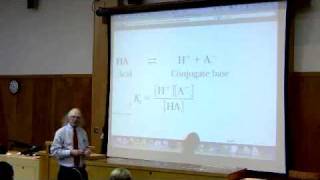
10. Many acids we find in cells are weak acids. Examples include acetic acid, which is a stronger acid than water, but a weaker acid than HCl. When we describe weak acids, we designate them by the letters HA. When the acid loses a proton, we refer to what is left as A-. The difference between HA and A- is clearly the proton that is lost. We refer therefore to HA as the ACID and A- as the SALT. I will avoid using the term BASE wherever I can in this class. To reiterate, the difference between an acid and a salt is a proton.

11. If one has an acid that loses one proton per 1000 molecules, it is a stronger acid than one that loses one proton per 100,000 molecules.

12. A weak acid has the ability, under proper circumstances to absorb or donate protons to resist changes that happen to the solution in which the buffer is located. This ability to resist changes in proton concentration means that solutions of weak acids resist (within certain ranges), changes in pH.

13. The Henderson-Hasselbalch equation (pH = pKa + log [A-]/[HA] (where A- is what I called the 'salt' and HA is the acid) allows one to measure the pH of a solution of a weak acid if one knows the pKa and the amount of salt and acid. It also allows one to determine the amount of salt and acid if one knows the pH and pKa.
More from this channel
-
 0:56
When Acids are Oxidized
-
 0:30
How to do "The Wiggle", part 2
-
 0:18
How to Do "The Wiggle", part 1
-
 14:52
Water, Acids, and Buffers in Biochemistry by Kevin Ahern, Part 5 of 8
-
 14:51
Water, Acids, and Buffers in Biochemistry by Kevin Ahern, Part 3 of 8
-
 14:41
Amino Acid Structure and Charge by Kevin Ahern, Part 1 of 4
-
 14:31
Amino Acid Structure and Charge by Kevin Ahern, Part 2 of 4
-
 14:44
Protein Structure and Function by Kevin Ahern, Part 5 of 8