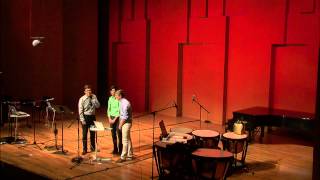
Three modules from An Unaware Cosmos by Joseph Klein
2,067 views · Published 25 March 2014 · 12:41 · Indexed 30 September 2026
Channel: University of North Texas College Concerts · 2014 · Music
An Unaware Cosmos: modular cycle for multiple soloists and chamber ensembles (2012–2017) by Joseph Klein (b. 1962), UNT Composition Faculty
World Premiere

Transient Dominion:
Toshiro Chun, trumpet
Colby Norton, bass trombone
Jacob Harpster, percussion
Éva Polgár, piano

The Indelible Stamp of Our Lowly Origin:
Jon Kern Anderson, Julia Milrod, Jesus Insuasty, and Gabriel Sakamoto, contrabasses

Unweaving a Rainbow:
Susan Dubois, viola
Steven Harlos, piano

"In recent years, I have become increasingly compelled to compose a work that pays homage to reason and rational thought, and to those freethinkers who have devoted their lives to such noble pursuits—many of whom suffered persecution and punishment by the authorities of their respective eras. Scientists, philosophers, writers, and political figures including Thomas Paine, Carl Sagan, Stephen Hawking, Bertrand Russell, Baruch Spinoza, Thomas Jefferson, Stephen Jay Gould, Charles Darwin, and Galileo Galilei are among those who have inspired these varied works, collectively titled An Unaware Cosmos. Concepts relating to cosmology, evolutionary biology, genetics, and humanism have informed this modular work for mixed ensembles, ranging from duos to full orchestra.

"This evening's program includes three out of what will eventually be over two-dozen individual modules for various combinations of instruments; the mutable arrangement of these modules is intended to explore a variety of relationships—timbral, spatial, conceptual, structural-both within and between modules. In the unfolding of this work, music from these various modules is fragmented, dislocated, suspended, disrupted, and penetrated in often unpredictable ways. This modular approach to form is related to the very premise of the work, and is analogous to what is referred to in cosmology as the Weak Anthropic Principle—i.e., that our perception of the Universe is the result of an anthropocentric bias: rather than being custom-made and nine-tuned to accommodate life, this principle posits that only in a universe capable of eventually supporting life will there be intelligent beings capable of presuming any such fine tuning, whereas a universe less compatible with life will go unobserved. Applying this concept to temporality with regard to sound structures suggests that our perception of musical form is the result of centuries-old cultural biases, which themselves have been called into question by recent generations of composers.

The three movements included on this evening's program are preceded by the following epigraphs, which serve as the metaphorical impetus for each:

'Look in the mirror, and don't be tempted to equate transient domination with either intrinsic superiority or prospects for extended survival.' — Stephen Jay Gould, Full House (1996)

'We must, however, acknowledge, as it seems to me, that man with all his noble qualities, with sympathy which feels for the most debased, with benevolence which extends not only to other men but to the humblest living creature, with his god-like intellect which has penetrated into the movements and constitution of the solar system - with all these exalted powers — Man still bears in his bodily frame the indelible stamp of his lowly origin.' — Charles Darwin, The Descent of Man (1871)

'Philosophy will clip an Angel's wings, Conquer all mysteries by rule and line, Empty the haunted air, and gnomed mine-Unweave a rainbow, as it erewhile made The tender-person'd Lamia melt into a shade.' —John Keats, Lamia (1819) [commentary on Sir Isaac Newton's Opticks]
—Joseph Klein, program notes

Recorded live March 18, 2014
Voertman Hall
College of Music
University of North Texas
Video by UNT Recording Services

https://josephkleinmusic.com/
https://music.unt.edu/composition/index.html
https://recording.music.unt.edu/
More from this channel
-
 5:47
A Tour of the Murchison Organ by Hellmuth Wolf Part 1
5:47
A Tour of the Murchison Organ by Hellmuth Wolf Part 1
-
 4:37
New Age by Ryan Fellhauer, Jen Hill, and Will King
4:37
New Age by Ryan Fellhauer, Jen Hill, and Will King
-
 9:15
UNT A Cappella Choir: Howells - Take him, Earth, for Cherishing
9:15
UNT A Cappella Choir: Howells - Take him, Earth, for Cherishing
-
 22:08
Pathways III: Interior Shadows by Joseph Klein
22:08
Pathways III: Interior Shadows by Joseph Klein
-
 2:06
UNT Harp Beats - Inspector Gadget Theme
2:06
UNT Harp Beats - Inspector Gadget Theme
-
 1:24
Historical Harp Donation to UNT - Brief
1:24
Historical Harp Donation to UNT - Brief
-
 8:49
UNT NOVA Ensemble: pas de loup by Ryan Fellhauer
8:49
UNT NOVA Ensemble: pas de loup by Ryan Fellhauer
-
 59:09
UNT Wind Symphony: Martín's Anna's Gift
59:09
UNT Wind Symphony: Martín's Anna's Gift