Problem No.2 on Complex Number | Ekeeda.com
552 views · Published 20 September 2015 · 10:48 · Indexed 5 October 2026
Channel: Ekeeda · 2015 · Education
Complex Number:

Complex numbers extend the concept of the one-dimensional number line to the two-dimensional complex plane by using the horizontal axis for the real part and the vertical axis for the imaginary part. The complex number a + bi can be identified with the point (a, b) in the complex plane. A complex number whose real part is zero is said to be purely imaginary, whereas a complex number whose imaginary part is zero is a real number. In this way, the complex numbers are a field extension of the ordinary real numbers, in order to solve problems that cannot be solved with real numbers alone.

As well as their use within mathematics, complex numbers have practical applications in many fields, including physics, chemistry, biology, economics, electrical engineering, and statistics. The Italian mathematician Gerolamo Cardano is the first known to have introduced complex numbers. He called them ""fictitious"" during his attempts to find solutions to cubic equations in the 16th century.


The length of the line segment, that is OP, is called the modulus of the complex number. The angle from the positive axis to the line segment is called the argument of the complex number, z. The modulus and argument are fairly simple to calculate using trigonometry.

In this unit you are going to learn about the modulus and argument of a complex number. These
are quantities which can be recognised by looking at an Argand diagram. Recall that any complex
number, z, can be represented by a point in the complex plane.

We can join point P to the origin with a line segment, as shown. We associate with this line segment
two important quantities. The length of the line segment, that is OP, is called the modulus of the
complex number. The angle from the positive axis to the line segment is called the argument of
the complex number, z.
The modulus and argument are fairly simple to calculate using trigonometry.

If you like our efforts, we request you to share our work with your friends & family BECAUSE YOUR LOVE ENCOURAGES US  TO PRODUCE MORE AND MORE GOOD CONTENT TO SPREAD THE FREE QUALITY EDUCATION.
You can also provide us Financial Help to continue this good work https://www.patreon.com/ekeeda
-~-~~-~~~-~~-~-

#OnlineLectures
#EducationForFree
#FullHD
#HappyLearning
#Engineering

Thanks For Supporting Us

Website - http://ekeeda.com
Parent Channel - https://www.youtube.com/c/ekeeda
Facebook - https://www.facebook.com/ekeeda.video
Twitter - https://twitter.com/Ekeeda_Official
Blogger - http://ekeeda.blogspot.in
Pinterest - https://in.pinterest.com/ekeedavideo
Digg - http://digg.com/u/ekeeda_Video
Tumbler - https://www.tumblr.com/blog/ekeedavideo
Reddit - https://www.reddit.com/user/ekeeda_Video
LinkedIn- https://www.linkedin.com/in/ekeeda-video-4a5b83124

Happy Learning : )
More from this channel
-
 10:58
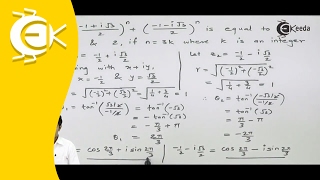
Numerical no.1 based on complex numbers in Part 3 | Ekeeda.com
10:58
Numerical no.1 based on complex numbers in Part 3 | Ekeeda.com
-
 13:27
Numerical no.2 based on complex numbers in Part 4 | Ekeeda.com
13:27
Numerical no.2 based on complex numbers in Part 4 | Ekeeda.com
-
 3:26
Learn Basic Physics Video Tutorials Online | Propogation | Ekeeda.com
3:26
Learn Basic Physics Video Tutorials Online | Propogation | Ekeeda.com
-
 7:26
Learn Basic Physics Video Tutorials Online | Problems and Formulaes Part 2 | Ekeeda.com
7:26
Learn Basic Physics Video Tutorials Online | Problems and Formulaes Part 2 | Ekeeda.com
-
 13:00
Learn Basic Physics Video Tutorials Online | Linear Simple Harmonic Motion | Ekeeda.com
13:00
Learn Basic Physics Video Tutorials Online | Linear Simple Harmonic Motion | Ekeeda.com
-
 3:09
Problem No.2 on Basic Concepts of Functions - Functions - Diploma Maths - II
3:09
Problem No.2 on Basic Concepts of Functions - Functions - Diploma Maths - II
-
 2:03
Problem No.1 on Transcendental Functions - Functions - Diploma Maths - II
2:03
Problem No.1 on Transcendental Functions - Functions - Diploma Maths - II
-
 5:57
Problem No.2 on Transcendental Functions - Functions - Diploma Maths - II
5:57
Problem No.2 on Transcendental Functions - Functions - Diploma Maths - II