How a genotype influence a phenotype?
1,965 views · Published 19 October 2013 · 3:14 · Indexed 17 October 2026
Channel: Nikolay's Genetics Lessons · 2013 · Education
How genotype affects phenotype

The term 'genotype' is usually used to refer to specific alleles. Alleles are alternative forms of the same gene that occupy the same location on a chromosome. At any given locus, there are 2 alleles (1 on each chromosome in the pair) -- you get 1 allele from your mother and 1 from your father. The 2 alleles might be the same or they might be different. Different alleles of a gene generally serve the same function (for example, they code for a protein that affects eye colour) but may produce different phenotypes (for example, blue eyes or brown eyes) depending on which set of 2 alleles you have.

For example, the ability to taste PTC (a bitter tasting compound) is controlled by a single gene. This gene has at least 7 alleles but only 2 of these are commonly found.

An upper case 'T' represents the dominant allele that confers the ability to taste -- 'dominant' means that anyone with 1 or 2 copies of this allele will be able to taste PTC. The non-tasting allele is recessive and is represented by a lower case 't' -- 'recessive' means that an individual will need 2 copies of the allele to be a non-taster.

Each pair of alleles represents the genotype of a specific individual, and in this case, there are 3 possible genotypes: TT (taster), Tt (taster) and tt (non-taster).

If the alleles are the same (TT or tt), the genotype is homozygous. If the alleles are different (Tt) the genotype is heterozygous.

It is actually rare that 1 gene determines 1 characteristic as in the case of PTC tasting (a monogenic trait). Most traits are complex and have genes that affect them at more than 1 locus (polygenic).
More from this channel
-
 5:53
Gene expression
5:53
Gene expression
-
 9:07
What are the Light and Heavy strands of DNA?
9:07
What are the Light and Heavy strands of DNA?
-
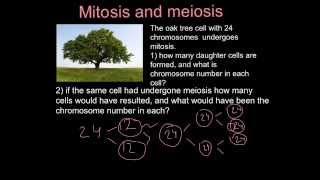 17:08
Mitosis and meiosis
17:08
Mitosis and meiosis
-
 14:48
Haplodyploidy in honeybees
14:48
Haplodyploidy in honeybees
-
 7:12
Single stranded DNA
7:12
Single stranded DNA
-
 4:11
Gregor Mendel, questions and facts
4:11
Gregor Mendel, questions and facts
-
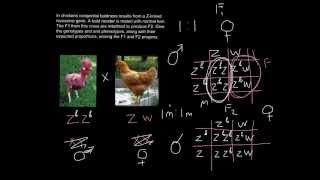 8:21
Сongenital baldness inheritance in birds ZZ/ZW
8:21
Сongenital baldness inheritance in birds ZZ/ZW
-
 4:38
Mendelian genetics, Punnett square problem solving (beginning level)
4:38
Mendelian genetics, Punnett square problem solving (beginning level)