Diversity of Early Christian Sects
994 views · Published 22 May 2017 · 16:21 · Indexed 26 September 2026
Channel: Evangelist Nick Garrett · 2017 · People & Blogs
Subscribe to my other non-fiction history channel - John Washington’s Channel – https://www.youtube.com/channel/UCPbWLFtuRC81ZUmWKdfn_wQ

Playlist of Previous Podcasts -https://www.youtube.com/playlist?list=PLMZXAYQL8tXlx0aOt4uOzQTvW2G03uR0B

“Found a Secret Hidden in the Bible” – https://www.youtube.com/watch?v=zRR5_z4MhHI

 “CRAZY MUST SEE NOW! Entire Bible Explained Like a Boss. Truth of Nephilim, Anunnaki, Bloodlines - https://www.youtube.com/watch?v=mpgSxuMputc

2 Creation Stories in Genesis are Different? What does it mean for the Bible? - https://www.youtube.com/watch?v=4xx9_B6XOvQ&t=311s
---------------------------------------------------------------------------------------------------
www.twitter.com/EvangelistNickG
www.facebook.com/EvangelistNickG

Purchase my books here -
www.amazon.com/author/nicholasgarrett

Just Tell Me the TRUTH About the Future of Christianity – Ebook $3.99 - Paperback only 7.99 -
Just Tell Me the TRUTH About the Crusades – 3.99 for Ebook - 7.99 Paperback
Just Tell Me the Truth About the Early Church Councils 2.99 Ebook $5.99 Paperback,

for collaboration or cross promotional opportunities please reach me at [email protected]

Footnotes
The quotes From Canon 2-Canon 19 are taken from among the “Canons of the First Council of Nicaea in 325 AD.”  www.papalencyclicals.com last accessed [November 28, 2016]

“Ignatius of Antioch: A True Roman” by, Mitchell F. Cordes The term meaning “universal” was first used in the letters written by Ignatius of Antioch after his arrest and during his trip to Rome to face martyrdom.  As he traveled toward Rome he stopped at major Christian cities along the way leaving letters, including directions for how he thought the Church should be run.  The term Katholikos represented Ignatius’ life’s work to model a hierarchy in the Church after Roman civil and municipal governmental structure. http://chrestomathy.cofc.edu/documents/vol11/cordes.pdf accessed [October 17, 2016]

The term "Quartodecimanism" (from the Vulgate Latin Quarta Decima in Leviticus 23:5, meaning fourteenth) refers to the custom of early Christians celebrating Passover beginning with the eve of the 14th day of Nisan (or Aviv in the Hebrew Bible calendar), which at dusk is biblically the "Lord's Passover". Google [November 3, 2016]

Acts Chapter 8

“Saints and Sinners: History of the Popes” Episode 1 Upon This Rock Produced by Opus Television for S4C Channel 4 Whales Television, UK – in association with RTE Ireland and LA 5 France.  Packaging, 1997 Acorn Media Publishing, Inc. [September 29, 2016, December 11, 2016]

 “Acts: Filled with the Holy Spirit” a biblical Commentary by John R. Rice A reoccurring theme for Rice is the idea that Romans and other gentiles greatly respected Judaism and it wasn’t uncommon to find the seats of the synagogue filled with gentiles.  While they hadn’t converted, they benefited from the teachings of the Torah and the Prophets.  ALSO Ryan Reeves, PhD, the Assistant Professor of Historical Theology at Gordon Cornwell Theological Seminary also highlights the subject in “Roman Pagan Life and Worship.” This lecture appears in a series on Church History on his youtube channel Ryan Reeves

Phil 1:2; Acts 2:42, 2:46, 5:42; 20:20; Col 4:15; I Cor 14:26, 16:1; Rom 12:4-8, 16:1-27; Matt 18:20; Tit 1:1-16;

Ryan Reeves, PhD, the Assistant Professor of Historical Theology at Gordon Cornwell Theological Seminary also makes this point in his lecture “Roman Pagan Life and Worship.” This lecture appears in a series on Church History on his youtube channel.  Early Christians were considered Atheists who had abandoned their God YHWH, because they rejected the practices of Judaism in varying degrees from sect to sect.

In Acts 5:34 Gamaliel convinced the Sanhedrin to simply let the Christians go suggesting that if it was of God they couldn’t stop the movement anyway, but if it was false teaching it would fizzle out on its own.

“James the Just and Christian Origins,” Edited by Bruce Chilton and Craig E. Evans pp. 299, supplement to Novum Testamentum, Leiden, brill 1999

“One Hundred Saints” pp. 46-47 “St. James the Less” Bulfinch Press Book, Little Brown and Co.

Some have suggested James was Jesus brother, while others his cousin.  The opinions vary from denomination to denomination.  Usually protestants say he was a brother, while Catholics, who for a time were intent on claiming Mary was ever virgin, claimed James had to be a cousin.

In Acts Chapter 15 it is clear that James had taken the Nazarite vow.  He would convince Paul to do the same.  It is assumed this is the same vow mentioned by Paul that he had taken.

“Survey of the New Testament” by: Paul N. Benware Moody Publishers 1990, 2003 The Apian Way was a famous Roman highway.
Initially there were no priests or pastors.  The individual presiding over the earliest Christian gentile weekly worship was called a “president” Justin Martyr “First Apology” Chapters 6 -7 (about 150 AD)
More from this channel
-
 12:55
"A Freedom that IS Free," Evangelist Nick Garrett Sermon from 2016
12:55
"A Freedom that IS Free," Evangelist Nick Garrett Sermon from 2016
-
 18:46
"Pruned for Eternity" Evangelist Nick Garrett Sermon at Union Church, 2016
18:46
"Pruned for Eternity" Evangelist Nick Garrett Sermon at Union Church, 2016
-
 9:40
The Waldensian Perspective and early Universalism
9:40
The Waldensian Perspective and early Universalism
-
 14:02
STUNNING Miracles of God in Antioch - First Crusaders prevailed, and turned to Jerusalem (6)
14:02
STUNNING Miracles of God in Antioch - First Crusaders prevailed, and turned to Jerusalem (6)
-
 5:30
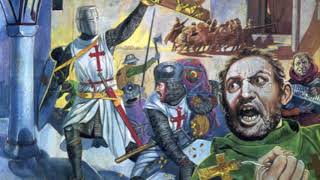
The Fourth Crusade - Attack on Constantinople - Failed Crusade (15)
5:30
The Fourth Crusade - Attack on Constantinople - Failed Crusade (15)
-
 6:28
Fifth Crusade Into the Holy Land - The Lead Up to the Crusade (19)
6:28
Fifth Crusade Into the Holy Land - The Lead Up to the Crusade (19)
-
 15:31
Future of Christian Sanctification - Soul Care and Denominationalism Thesis (Pt 1 of 2)
15:31
Future of Christian Sanctification - Soul Care and Denominationalism Thesis (Pt 1 of 2)
-
 9:13
What was going on in Catholicism during the Reformation? Correcting the mainstream view - informal
9:13
What was going on in Catholicism during the Reformation? Correcting the mainstream view - informal