How to solve MOST Simple Mendelian Genetics problems
1,234 views · Published 26 May 2016 · 37:56 · Indexed 12 November 2026
Channel: Nikolay's Genetics Lessons · 2016 · Education
Dihybrid cross is a cross between two different lines (varieties, strains) that differ in two observed traits. In the Mendelian sense, between the alleles of both these loci there is a relationship of complete dominance - recessive. In the example pictured to the right, RRYY/rryy parents result in F1 offspring that are heterozygous for both R and Y (RrYy).[1]

In the name "Dihybrid cross", the "di" indicates that there are two traits involved (e.g. R and Y), the "hybrid" means that each trait has two different alleles (e.g. R and r, or Y and y), and "cross" means that there are two individuals (usually a mother and father) who are combining or "crossing" their genetic information.

The Dihybrid cross is easy to visualize using a Punnett square of dimensions 4 x 4.

The rules of meiosis, as they apply to the dihybrid, are codified in Mendel's first law and Mendel's second law, which are also called the Law of Segregation and the Law of Independent Assortment, respectively.

For genes on separate chromosomes, each allele pair shows independent segregation. If the first filial generation (F1 generation) produces four identical offspring, the second filial generation, which occurs by crossing the members of the first filial generation, shows a phenotypic (appearance) ratio of 9:3:3:1, where:

the 9 represents the proportion of individuals displaying both dominant traits
the first 3 represents the individuals displaying the first dominant trait and the second recessive trait
the second 3 represents those displaying the first recessive trait and second dominant trait
the 1 represents the homozygote, displaying both recessive traits.
More from this channel
-
 5:53
Gene expression
-
 9:07
What are the Light and Heavy strands of DNA?
-
 17:08
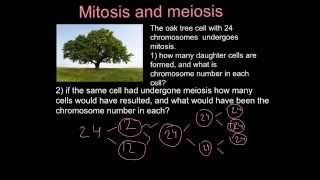
Mitosis and meiosis
-
 14:48
Haplodyploidy in honeybees
-
 7:12
Single stranded DNA
-
 4:51
How message RNA is read: duplets, triplets or tetraplets?
-
 4:11
Gregor Mendel, questions and facts
-
 8:21
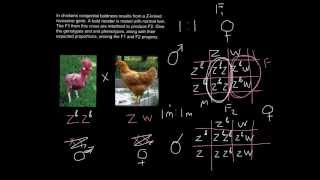
Сongenital baldness inheritance in birds ZZ/ZW