What is a probability for only paternal chromosomes to be inherited by the gamet?
3,081 views · Published 8 December 2013 · 7:24 · Indexed 22 September 2026
Channel: Nikolay's Genetics Lessons · 2013 · Education
During meiosis and due to independent assortment at metaphase I, the homologous chromosome pairs (one from Mom and one from dad for each type of chromosome) line up together. The first time the cell divides, one of each chromosome will go into each new cell, so they will be separated from each other. Each pair lines up independently of every other pair. Just because in the first pair mom's chromosome lines up on the left, and dad's on the right, has no influence on the next and subsequent pairs. So each cell is a random combination of Mom and dad's chromosomes. There are 2 chromosomes in each pair and 23 pairs of chromosomes, so there are 2 to the 23rd different ways these chromosomes can be arranged for each meiosis event.

That's about 8 million different ways. But that is not the whole picture. Because early in meiosis, when the pairs first get together before metaphase, they trade pieces of themselves, i.e., a piece breaks off of each and switches places. This is known as crossing over and it occurs at least once in every meiosis in every pair. And, lastly it is random as to which gamete is paired with the other gamete, i.e., one sperm makes it to the egg at random and one egg is ovulated each month at random. So although it is POSSIBLE to have two gametes be identical, it so highly unlikely that we say that each is unique. Of course, each individual only has the genetic material passed down from their parents to work with, and do not re-create it each time. So it is still possible to look at an offspring and say for instance-he or she has dad's eyes and grandma's nose. But none of the offspring will be genetic copies of either of the parents.
More from this channel
-
 4:38
Mendelian genetics, Punnett square problem solving (beginning level)
4:38
Mendelian genetics, Punnett square problem solving (beginning level)
-
 11:51
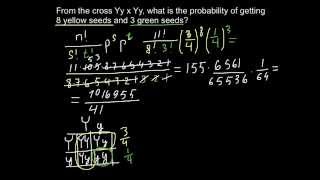
Factorial method and Genetics
11:51
Factorial method and Genetics
-
 17:11
Selection against homozygous recessive genotype
17:11
Selection against homozygous recessive genotype
-
 4:10
Sickle cell anemia - multiple choice questions
4:10
Sickle cell anemia - multiple choice questions
-
 13:20
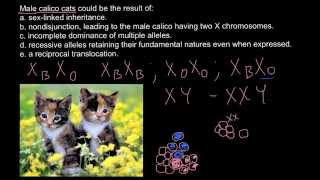
Could calico cats be male?
13:20
Could calico cats be male?
-
 5:35
Somatic cells, Chromosomes, Autosomes, Gametes explained
5:35
Somatic cells, Chromosomes, Autosomes, Gametes explained
-
 7:54
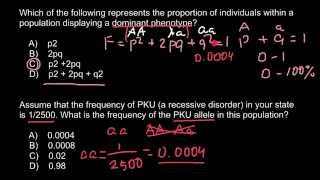
How to find frequency of alleles in a population?
7:54
How to find frequency of alleles in a population?
-
 4:43
Phenotype and Genotype
4:43
Phenotype and Genotype