Lightning Talk: Statistical Multiplexing
754 views · Published 14 April 2017 · 6:07 · Indexed 26 September 2026
Channel: NANOG · 2017 · Science & Technology
Speakers:
Jeff Franckhauser, XKL LLC.

Over the past two decades, ever-increasing bandwidth demand has become an increasing challenge and opportunity for growth within the networking market. The number of Internet users has skyrocketed alongside application bandwidth intensity, and the burgeoning Internet of Things is projected to exponentially strain networks. While many hardware vendors are experimenting with spectral efficiency, those gains take time and are expensive. One key solution lies in increasing efficiencies on the transport equipment that allocate traffic. Moving away from time-division multiplexing and coupling coherent technology’s “pool of bandwidth” with statistical multiplexing allows for more control of bandwidth allocation. Statistical multiplexing can greatly increase network performance at Layer 1, arguably the simplest network layer and the easiest one to work with. Layer 2+ equipment has traditionally leveraged time-division multiplexing, a mechanism in which all packet flows — even the idle ones — fill up a channel, leading to channel inefficiencies. By allocating bandwidth for channels with data packets, statistical multiplexing intelligently combines input traffic to maximize channel efficiency. Hear how this approach applies to Layer 1 equipment, transforming networks and helping service providers and end-users optimize their own networks.
More from this channel
-
 37:19
12 Mbps @ 36,000 ft. Coming attractions in in-flight broadband
37:19
12 Mbps @ 36,000 ft. Coming attractions in in-flight broadband
-
 45:30
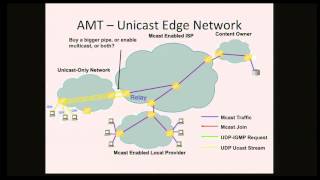
Internet Multicast: It's Still a Thing
45:30
Internet Multicast: It's Still a Thing
-
 1:17:57
ARIN Public Policy Consultation Track
1:17:57
ARIN Public Policy Consultation Track
-
 32:19
Source Routing 2.0. Why Now, Why Again?
32:19
Source Routing 2.0. Why Now, Why Again?
-
 21:49
Lost Stars - Why Operators Switch off IPv6
21:49
Lost Stars - Why Operators Switch off IPv6
-
 32:09
Virtualized PE for BGP-MPLS L3-VPN using Open-Source Software
32:09
Virtualized PE for BGP-MPLS L3-VPN using Open-Source Software
-
 36:49
Withstanding the Infinite: DDoS Defense in the Terabit Era
36:49
Withstanding the Infinite: DDoS Defense in the Terabit Era