May 11, 2016 The Angel of Death
243 views · Published 20 May 2016 · 15:48 · Indexed 9 October 2026
Channel: Sea lion Defense Brigade · 2016 · Education
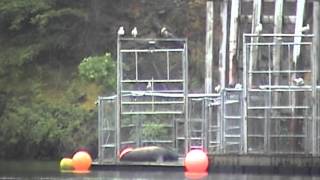
Sea Lion Defense Brigade 0bserver video from the trapping and off loading of four California sea lions for lethal removal on
 May 11, 2016 for consuming some returning adult salmon out of the Columbia River below the Bonneville Dam.

Scapegoating and killing sea lions under the guise of
saving the salmon has only provided a smoke screen and a distraction away from the ultimate causes of esa salmon mortality on the Columbia River.  Moreover blaming and killing sea lions has not increased populations of esa salmon nor has it provided measurable results like unblocking the 50,000 currently blocked fish passages across Oregon and Washington State will.
In addition investing in toxic remediation will provide protection for esa salmon populations and actually aid in esa salmon recovery efforts in which blaming and killing sea lions does not do.

“Most predation occurs when young fish migrate downstream to their adult habitat the sea"  --  Dr. Gary Grossman.

Here are ten reasons out of many as to why Oregon ought not waste our tax dollars to kill sea lions for consuming some salmon
out of the Columbia River below the Bonneville Dam.

1. At least 54% of the resident fish species in Washington, 50% in Oregon, and 60% in Idaho are non-natives (Sanderson, etal.2009).

2.   The northern pikeminnow is clearly the most abundant and significant fish predator of juvenile salmonids in the lower Columbia River above Astoria (Friesen and Ward 1999).

3.  Pikeminnow appear to aggregate in the tailraces of dams, where they feed on disoriented salmon smolts (McNary Dam, Poe et al. 1991; and elsewhere, Ward et al. 1995), and at sites in Bonneville Pool where hatchery-origin salmonids are released (Collis et al. 1995).

4. The presence of nonindigenous fishes poses one of the greatest threats to the persistence of healthy native fish populations (Lassuy 1995, Richter et al. 1997, Rahel 2002).

5.   Smallmouth bass have changed the size-based predation dynamics in some areas where they have largely displaced the native predator, northern pikeminnow  (Ptychocheilus oregonensis Fritts and Pearsons 2006)

6.  NIS Fish consume millions of baby salmon smolt yearly. http://bioscience.oxfordjournals.org/content/59/3/245.full

7.  This all-“H”-centric view has largely ignored the impacts of key NIS in Pacific Northwest watersheds, which may  rival the detrimental effects of the all-H's (Ruckelshaus et al. 2002).


8.   The sea lions are opportunistic eaters and they consume a variety of prey. Their diets tend to fluctuate by location and prey available and in the most abundance so the Sea Lions aid the state in salmon recovery by consuming these NIS & hatchery fish.

9.  The sea lions have an important job to do. The sea lions help create the lushness of phytoplankton which are the cornerstone of the food chains for all life in the ocean.  Sea lions and seals help feed and assist with fish distribution throughout the basin. The science supports the importance of key stone and indicator species in our region and that removing them can cause more detriment to the ecology and fisheries than good.

10. The Columbia River Estuary has always been home to sea lions and other marine mammals. The Columbia River Estuary extends 146 miles from the mouth of the Columbia River to the Bonneville Dam.

In Closing  Sea lions and  wild salmon are both important key stone species in the Pacific Northwest Bio Region. They are both native to the Columbia River estuary ecology and the presence of sea lions and wild salmon help support the food web in the estuary they do not hinder it.
______________________________________________________________

“Unfortunately the endangered salmon reside in a highly altered habitat difficult to establish a hierarchy on the cause effecting salmon mortality. Consequently assigning a value to potential increase in of salmon abundance that will be produced by predator control is problematical. When compared to increases potentially from other remediation of other negative influences such as degraded habitat, altered flow regime and contaminants. “ -----  Dr. Gary Grossman*

*Since 1981, Dr. Grossman has been a professor of animal ecology from the University of Georgia. His primary research areas are “population dynamics and habitat selection and fishes.” He has published over one hundred and fifteen scientific papers, cited over 5,000 times. For the last twenty years has been advising fisheries agencies in California. In addition, in 2013 led a public hearing on the effects of fish predation on endangered salmonids that produced a technical report. He has recently completed a general review on the effects of predators on San Joaquin Deltas fishes, to be published   in “State of Delta’s Science”
More from this channel
-
 0:22
Another Slow Death By Fishermen
0:22
Another Slow Death By Fishermen
-
 0:35
Fishermen Kill Fish while Sea Lions DIE for Eating
0:35
Fishermen Kill Fish while Sea Lions DIE for Eating
-
 0:38
Bonneville Dam 5/21/12
0:38
Bonneville Dam 5/21/12
-
 2:57
Sharon Young with HSUS Speaks about the Bonneville Sea Lions 2010
2:57
Sharon Young with HSUS Speaks about the Bonneville Sea Lions 2010
-
 2:28
Matt Rossell Pinniped Task Force 2010 The Salmon Need Real Recovery
2:28
Matt Rossell Pinniped Task Force 2010 The Salmon Need Real Recovery
-
 0:27
Grease Board Pinniped Task Force 2010
0:27
Grease Board Pinniped Task Force 2010
-
 1:08
Pinniped Task Force Members 2010
1:08
Pinniped Task Force Members 2010
-
 0:50
Slooooow Death by Fishermen
0:50
Slooooow Death by Fishermen