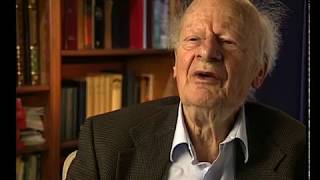
James Black - Realising a new drug is needed for heart failure (28/33)
181 views · Published 28 June 2017 · 4:15 · Indexed 20 September 2026
Channel: Web of Stories - Life Stories of Remarkable People · 2017 · Science & Technology
To hear more of James Black’s stories, go to the playlist: https://www.youtube.com/watch?v=T40sQxRoDwA&list=PLVV0r6CmEsFxj8rsp51ptesTyqLBftzPD

The late Scottish pharmacologist Sir James W Black (1924-2010) revolutionised medical treatment of hypertension and angina with his invention of propranolol, the first ever beta blocker. He was awarded the Nobel Prize in Physiology or Medicine in 1998. [Listener: William Duncan; story recorded: 2006]

TRANSCRIPT: Now, let me tell you more about heart failure patients. Normally, there's more beta-1 than beta-2. But in heart failure, the beta-1 concentration is halved, or even less. The beta-2 aren't; indeed, may increase a bit. Second, the levels of adrenaline in the blood go up and it's usually argued by clinicians that this is a compensatory mechanism to, if you like, give the heart stimulation to keep it going. But the fact is that adrenaline, in so far as it's acting on the heart, encourages the phosphorylation of... I've missed out the GI. I've got to go back to that, haven't I?

[WD] Well, I thought that's where you were going.

Well, let me go back to that, then, Bill. So, when I started in the atrium we had – I didn't know that... have only got beta-1 receptors; the ventricles have got beta-1 and beta-2. These beta receptors, beta-1 and beta-2, couple to different G-proteins. Beta-1 couples to GS – stimulation – switches on the phosphorylating enzymes. GI also couples to GS but when it's phosphorylated, whereas beta-1 is inactivated, beta-2 now switches on GI, so the phosphorylated beta-2 receptor is producing GI-proteins which inhibit the force of contraction and do a whole of series of switching on of various kinases which are involved in programmed cell death, in stimulation of fibrosis; all the, kind of, nasty things which go on in the failing of a heart, are switched on by GI-proteins. So my model then is that it would take patients with heart failure, beta-1 are reduced, beta-2 aren't, adrenaline's up, you are increasing the amount of phosphorylated beta-2, and so there's a lot of GI production in the failing heart and there is evidence for that. And my theory is that these beta blockers are acting, not because they take out beta-1, indeed that's why I think the patients do badly on day one, but because they take out beta-2 and all these GI, and again it takes time for the reduction in GI to occur for these changes in the heart and restructuring and reshaping. So that's then... what I felt we needed was a selective beta-2 antagonist. Well, I told you, ICI's had one since the '70s. Indeed, many drug companies produced them, but these drugs are now way out of patent, and so I was unable to persuade AstraZeneca to renew the toxicology on that compound to bring it up to date so that we could use it clinically. So I have decided I'll make my own and I got a grant from a... a charity, a Jewish charity, offshore charity, called The Dorset Foundation, and they funded me to have two PhD students – one in chemistry and one in pharmacology – and we... the... the pharmacology chap, he has got all his assays going now after a year. The chemistry one we had difficulty recruiting, so eventually we... we recruited a post-doc, and so we've... taking our three year funding down to two years for him, and he'll get his own grant.
More from this channel
-
 1:32
Murray Gell-Mann - Quarks, mass shell analysis and the bootstrap (102/200)
1:32
Murray Gell-Mann - Quarks, mass shell analysis and the bootstrap (102/200)
-
 1:22
John Maynard Smith - Speculations on the origins of life and Haldane's 3 theorems (102/102)
1:22
John Maynard Smith - Speculations on the origins of life and Haldane's 3 theorems (102/102)
-
 2:00
John Maynard Smith - Experiencing feminism in science (83/102)
2:00
John Maynard Smith - Experiencing feminism in science (83/102)
-
 1:34
Brian Aldiss - Charles Monteith – a kindred spirit (17/79)
1:34
Brian Aldiss - Charles Monteith – a kindred spirit (17/79)
-
 4:00
Hans Bethe - The importance of support for pure science (97/158)
4:00
Hans Bethe - The importance of support for pure science (97/158)
-
 4:06
Hans Bethe - Outbreak of World War II; scientists' efforts (82/158)
4:06
Hans Bethe - Outbreak of World War II; scientists' efforts (82/158)
-
 2:03
Hans Bethe - Short range order vs long range order in the metal alloy (46/158)
2:03
Hans Bethe - Short range order vs long range order in the metal alloy (46/158)
-
 3:00
Baruch Blumberg - Getting married and continuing with clinical research (14/80)
3:00
Baruch Blumberg - Getting married and continuing with clinical research (14/80)